

U.S. Auto Warranty Expenses:
The major U.S.-based automakers saw increases in their warranty costs in 2025, and added in billions of additional funds into their warranty reserves, to account for higher-than-anticipated warranty costs for vehicles sold in previous years.
Inflation and tariffs drove up warranty costs for the largest U.S.-based automakers in 2025. Total warranty claims paid, accruals made, and reserves held amongst the largest American passenger vehicle OEMs reached new record highs in calendar 2025. Warranty costs for vehicles sold prior to 2025 have also proven higher than expected, resulting in additional changes of estimate to previous accruals.
Setting new records in warranty costs has become the new normal in the American auto industry. Furthermore, in recent years, it's also become the norm to set aside large changes of estimate to previous accruals, as tariffs and inflation have driven up the price of parts and labor for warranty work to higher than the actuaries expected a few years ago.
Increases in warranty accruals mean that the U.S.-based vehicle OEMs are expecting higher warranty costs for new vehicles. Additional "changes in accrual related to pre-existing warranties," which we call changes of estimate, mean that the automakers needed to set aside extra chunks of money to cover the shortfalls in past warranty accruals.
In 2025, General Motors set aside $5.1 billion in warranty accruals, associated with vehicles sold in 2025. In addition, GM set aside another $3.25 billion in changes of estimate, to account for the disparity between the anticipated and the real warranty costs for vehicles sold prior to 2025.
Similarly, Ford set aside $6.7 billion in warranty accruals in 2025, and another $2.3 billion in changes of estimate to previous accruals. Tesla set aside $2.5 billion in regular accruals in 2025, and another $1.1 billion in changes of estimate.
American Automakers
To create this newsletter, we gathered data from the annual reports and quarterly financial statements of the largest U.S.-based automakers. We collected data from Ford Motor Co., General Motors Co., Tesla Inc., Rivian Automotive Inc., and Lucid Group Inc.
Rivian began reporting its warranty expenses in 2023, though it did include figures on warranty reserves for 2022. Lucid started reporting in 2022, but its warranty costs are still too small to show up on our charts. Rivian just barely shows up, so we included the company in our charts for the first time.
Note that Chrysler, while considered an American car brand, is owned by parent Stellantis, based in the Netherlands, and thus considered a European automaker in our data. Although Lucid Group is majority owned by the Saudi Arabia Public Investment Fund, it is headquartered in the U.S., and files quarterly and annual reports with the U.S. Securities and Exchange Commission, and thus considered U.S.-based in our data.
From each automaker, we gathered three key warranty metrics: the amount of claims paid, the amount of accruals made, and the end-balance of the warranty reserve fund. We also gathered data on each manufacturer's quarterly product sales revenue, in order to calculate two additional warranty metrics: claims as a percentage of sales (the claims rate), and accruals as a percentage of sales (the accrual rate).
In addition, we gathered data on each manufacturer's quarterly changes of estimate to accruals made during previous periods. The majority of changes of estimate are additional funds deposited into the warranty reserves to correct under-estimation of the product's future warranty costs.
We don't add changes of estimate into our total accrual calculations, since these adjustments affect funds accrued during previous periods, and we'd run the risk of double-counting the same funds twice if we did this categorically. However, these figures add a key dimension to our discussion of the effects of tariffs, inflation, and labor shortages on rapidly rising warranty costs.
Warranty Claims Totals
Figure 1 show the total quarterly warranty claims paid by the largest U.S.-based automakers, from 2021 to 2025.
Figure 1
U.S.-based Auto Manufacturers
Claims Paid per Quarter
(in millions of U.S. dollars, 2021-2025)
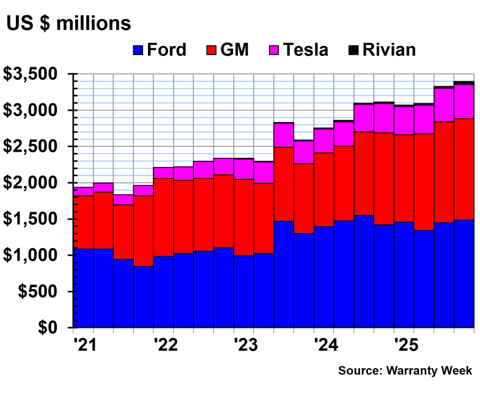
Ford paid $5.73 billion in warranty claims in 2025, down -2% from 2024. Ford's quarterly claims costs in 2025 ranged from $1.34 billion in the second quarter, to $1.49 billion in the fourth quarter.
GM paid $5.32 billion in warranty claims in 2025, up 19% from 2024. The quarterly costs ranged from $1.20 billion in the first quarter, to $1.40 billion in the fourth quarter.
Tesla paid $1.72 billion in warranty claims in 2025, an increase of 19% from 2024. The quarterly claims costs ranged from $392 million in the first quarter, to $469 million in the fourth quarter.
Rivian paid $110 million in warranty claims in 2025, up 62% from 2024. Its quarterly claims costs ranged from $18 million in the second quarter, to $42 million in the fourth quarter.
Lucid paid $31 million in warranty claims in 2025, a decrease of -42% from 2024.
Warranty Claims Rates
Figure 2 shows the quarterly warranty claims rates of these four U.S.-based auto OEMs, from 2021 to 2025.
Figure 2
U.S.-based Auto Manufacturers
Warranty Claims Rates
(as a % of product sales, 2021-2025)
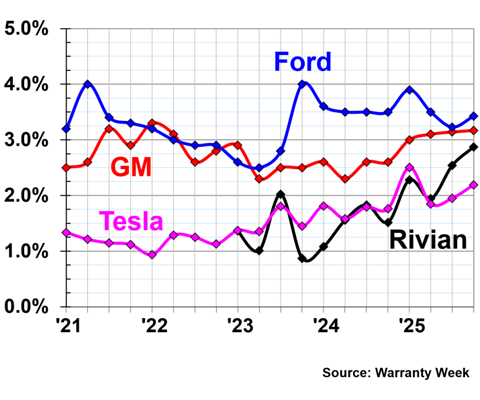
In the fourth quarter of 2025, Ford had a claims rate of 3.4%, GM had a claims rate of 3.2%, Rivian had a claims rate of 2.9%, and Tesla had a claims rate of 2.2%.
Ford began 2025 with a claims rate of 3.9% in the first quarter, which fell as the year went on. Tesla's claims rate started quite elevated at 2.5% in the first quarter of 2025, then fell over the course of 2025 as well.
GM's claims rate increased slightly over the course of 2025, from 3.0% in the first quarter to 3.2% in the fourth quarter.
Rivian's claims rate increased steeply in the second half of 2025, from 1.9% in the second quarter, to 2.9% in the fourth quarter.
Warranty Accrual Rates
Figure 3 shows the total warranty accruals made by the largest U.S.-based automakers, from 2021 to 2025.
Keep in mind that the largest U.S.-based automakers also set aside additional funds in changes of estimate to warranty accruals made in previous years. GM set aside an additional $3.25 billion in changes of estimate, Ford set aside an additional $2.3 billion, and Tesla set aside an additional $1.1 billion.
Figure 3
U.S.-based Auto Manufacturers
Accruals Made per Quarter
(in millions of U.S. dollars, 2021-2025)
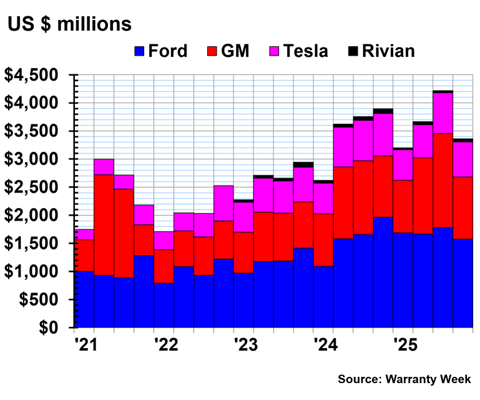
Ford set aside $6.71 billion in warranty accruals in 2025, an increase of 7% from 2024. Ford's quarterly warranty accruals ranged from $1.58 billion in the fourth quarter, to $1.78 billion in the third quarter.
GM set aside $5.07 billion in warranty accruals in 2025, an increase of 10% from 2024. GM's quarterly warranty accruals ranged from $932 million in the first quarter, to $1.68 billion in the third quarter.
Tesla set aside $2.49 billion in warranty accruals in 2025, a decrease of -9% from 2024. Tesla's quarterly warranty accruals ranged from $543 million in the first quarter of 2025, to $727 million in the third quarter.
Rivian set aside $184 million in warranty accruals in 2025, a decrease of -30% from 2024.
Lucid set aside $71 million in warranty accruals in 2025, a decrease of -41% from 2024.
Warranty Accrual Rates
Figures 4a and 4b show the quarterly warranty accrual rates of these automakers, from 2021 to 2025.
Figure 4a includes Rivian. However, it is clear that Rivian's astronomical accrual rate of 26% in the first quarter of 2022 throws off the y-axis scale of this chart, and makes it difficult to see the accrual rates of GM, Ford, and Tesla. Therefore, Figure 4b shows the same data, excluding Rivian, so we can better visualize the 2025 accrual rate data.
Figure 4a
U.S.-based Auto Manufacturers
Warranty Accrual Rates
(as a % of product sales, 2021-2025)
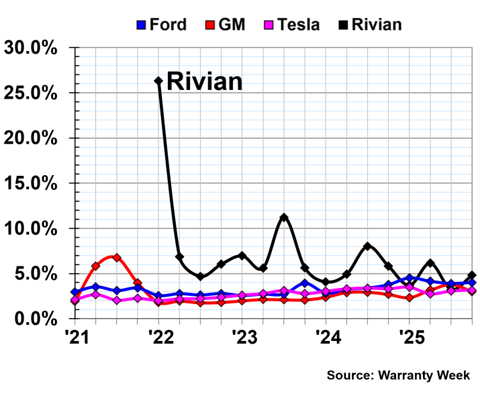
Rivian had a warranty accrual rate of 4.8% in the fourth quarter of 2025. The quarterly percentages ranged from 3.2% in the third quarter, to 6.2% in the second quarter.
Let's take a closer look at the warranty accrual rates of Ford, GM, and Tesla in Figure 4b.
Figure 4b
U.S.-based Auto Manufacturers
Warranty Accrual Rates
(as a % of product sales, 2021-2025)
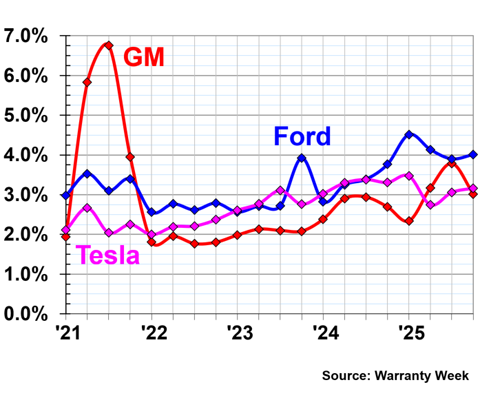
In the fourth quarter of 2025, Ford had a warranty accrual rate of 4.0%. Ford's 2025 quarterly accrual rates ranged from 3.9% in the third quarter, to 4.5% in the first quarter.
GM had a warranty accrual rate of 3.0% at the end of 2025. GM's quarterly accrual rates ranged from 2.3% in the first quarter, to 3.8% in the third quarter.
Tesla had an accrual rate of 3.2% at the end of 2025. Tesla's quarterly accrual rates ranged from 2.7% in the second quarter, to 3.5% in the first quarter.
Warranty Reserve Balances
Finally, Figure 5 shows the total warranty reserves held by each U.S.-based automaker at the end of each quarter, from 2021 to 2025.
Figure 5
U.S.-based Auto Manufacturers
Reserves Held per Quarter
(in millions of U.S. dollars, 2021-2025)
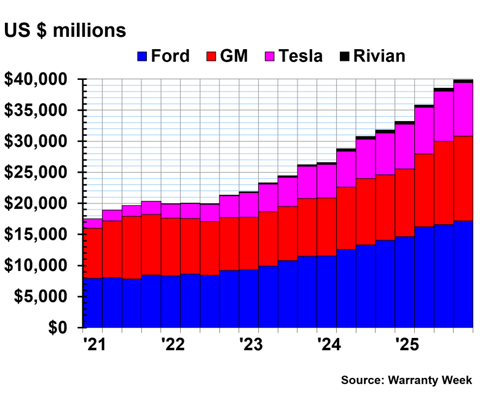
At the end of 2025, Ford held $17.19 billion in warranty reserves, an increase of 23% from the end of 2024. GM held $13.63 billion in warranty reserves, an increase of 29% from the end of 2024.
Tesla held $8.61 billion in warranty reserves at the end of 2025, an increase of 28% from the end of 2024. Rivian held $463 million, a decrease of -2% from the end of 2024. And Lucid held $527 million in warranty reserves at the end of 2025, an increase of 66% from the end of 2024.