

Agentic AI for VSC Claims Processing:
Six months since vehicle service contract (VSC) provider CARS Protection Plus announced its partnership with Circuitry.ai, we caught up with the CEOs of the two companies. We discussed innovations in the warranty claims lifecycle, including the claims scoring system, the intelligent claims intake form, and other AI-powered features, along with the collaborative development process, and the many data inputs and outputs processed by Circuitry's AI solutions.
Warranty administration platforms are good at collecting and storing data, but older systems have their limitations and inefficiencies. Claims adjudicators spend a lot of time doing manual data entry, and retrieval of individual files and reports, rather than making decisions. Repair shops and dealers spend time filling out repair orders, just to re-enter the data into an online form, or read out the information over the phone. Artifical intelligence offers the opportunity to streamline these processes, enabling stakeholders throughout the warranty lifecycle to engage with the key aspects of their work.

Ashok Kartham, founder and CEO of Circuitry.ai, knows the limitations of older warranty administration platforms — he designed many of those solutions. Kartham has been a pioneer in bringing warranty into the digital age for over three decades. As President and CEO of 4CS, Kartham helped digitize warranty claims management. 4CS was acquired by PTC in 2011. Not one to stop innovating, Kartham founded Mize in 2012, to utilize cloud-based processing for warranty claims management, and bring warranty registration and customer care to the mobile format. Mize merged with Syncron in 2021.
"There were significant benefits, first from the digitization of the warranty claims process, and then from companies moving to cloud-based systems. That's what I was involved with in my previous two companies," said Kartham.
True to his nature, Kartham soon saw another opportunity to bring warranty into the newest technological frontier, artificial intelligence. He founded Circuitry.ai in 2023, to develop AI applications across the warranty lifecycle.
As Kartham saw firsthand, "Current warranty administrative systems are capturing data well. The new gap is, how do you use that information to make better decisions? Whether that's about diagnostics, repair, claims, eligibility, or even quality and early warning, how do you take it to the AI era? With AI, companies can make better decisions about claims, automate some of the claims adjudication, and also support their customers and dealers a lot better. It helps make that decision a lot faster and more consistently than adjusters are able to do," said Kartham.
Improving Workflows Without Reducing Headcount
In May 2026, CARS Protection Plus, a provider of vehicle service contracts, announced that it had gone live with Circuitry.ai's Warranty Decision Intelligence platform. This announcement came just three months after development of the pilot program began.

Lance LaCoe, President and CEO of CARS Protection Plus, told us, "It was exactly the right time for us to go down this path together. We were really pushing against the limitations of our administration system."
CARS Protection Plus sells VSCs for used vehicles through an extensive nationwide network of franchises and independent dealers. "Service contracts for used vehicles are different. We tend to get a lot more early claims for a used vehicle, compared to a new vehicle," said LaCoe.
"Our business has grown tremendously over the past three years, with very strong double-digit growth year-over-year, in terms of the number of contracts. We have hired a tremendous amount of people to help us keep pace with that growth, but what we really need are better tool sets available to help us be more efficient, provide better and more consistent answers, and more timely information out to our repair facilities and customers," said LaCoe.
Highlighting the same problem Kartham identified, LaCoe stated, "Our warranty administration platform is great at being a filing cabinet. But, it's not really so great at making sure that we're providing responses quickly, that we're answering the right claims in the right time, that we're meeting service-level commitments."
"We're adding Circuitry.ai's Warranty Decision Intelligence to CARS Protection Plus' claims operations to help them scale without adding headcount," said Kartham.
LaCoe added, "When we explored bringing in Circuitry, our expected ROI was not based on reducing headcount. What we were looking at is, how can we get better at making sure that we pay the right amount on every claim?"
LaCoe has seen CARS Protection Plus through a high-growth phase since 2020, when Spectrum Automotive Holdings acquired the VSC provider. "We have plenty of growth," said LaCoe. "What I'm trying to do is to use technology, so we aren't always behind on the number of people that we need to staff. It's really helping us be staffed more appropriately through a high-growth phase."
As a bonus, there's some money to be made from improving claims workflows with AI. "We think that there's a very low single digit that we can achieve in regard to lower claim payments," said LaCoe. "And it's not by paying fewer claims, it's by paying the right amount on each claim. And at our volume, a lower one, two, or three percent on total claims paid, it adds up to a lot of money."
AI Agents for the Warranty Lifecycle
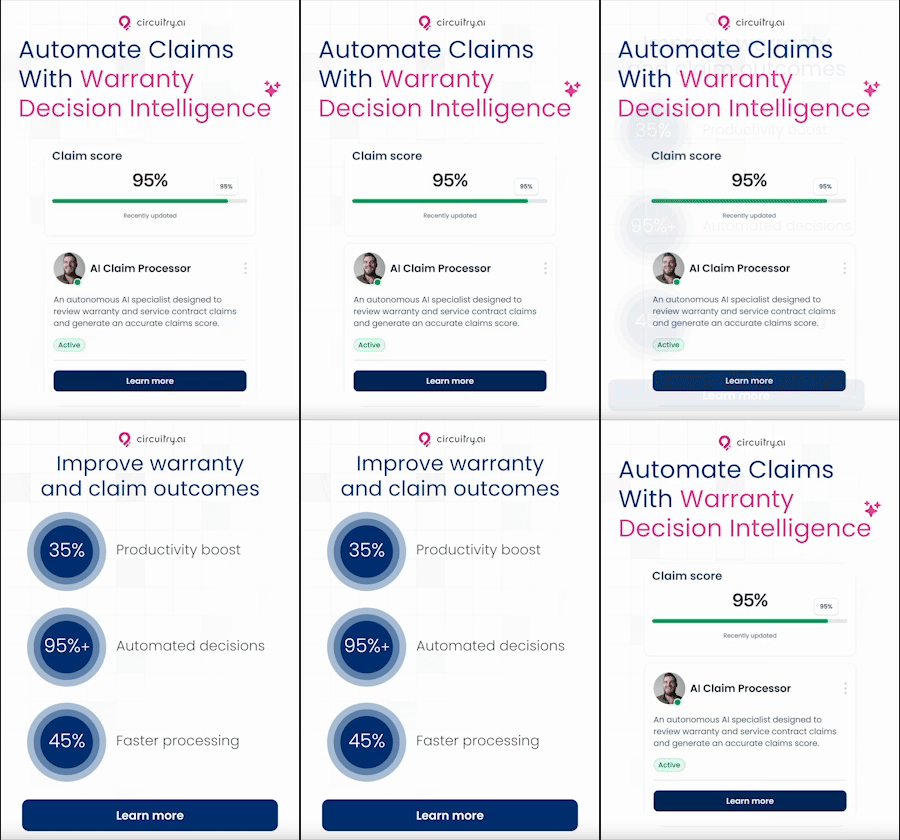
The initial partnership between Circuitry.ai and CARS Protection Plus focused on implementing claims scoring, drawing data from a wide variety of sources to help adjudicators make faster and more consistent claims decisions.
"Our AI advisors, analysts, and agents work alongside CARS Protection Plus' team to answer, decide, and act across the claims lifecycle, from intake to payment. By helping validate claims against third-party data sources for vehicle history, labor times, and parts pricing, we help CARS reduce claims costs, and make faster, more consistent decisions, all while keeping their team in control and improving service for repair facilities and contract holders," said Kartham.
"We develop a wide variety of AI agents for multiple use cases," said Kartham. "One we call the warranty advisor, which is able to answer any questions related to the contracts or claims. We are providing claim scoring. We are looking up information from lots of different sources, from vehicle history record, to labor information, parts information, and beyond."
"We are also able to automate the payment process. AI is able to understand repair orders that are being uploaded by the dealers or the service providers, and can match against the claim, validate the repair order, and provide all of the evidence required to support the payment."
Intelligent Claim Intake Form
An early win for the partnership was the rollout of the intelligent claim intake form, which has driven up digital input of claims from repair shops and dealers in just a few months.
In the previous system, data entry and pulling files was slowing down claims adjudication. LaCoe stated, "Prior to Circuitry.ai, if somebody went to our website to submit a claim, they would manually type in all of the information. We would then receive a form, and our adjuster would take that information and re-enter it into our warranty administration platform. So, it was multiple entries."
"Circuitry takes the information from the claim intake form on our website, and it pushes it into our warranty administration platform for us," said LaCoe.
Initially, said LaCoe, "we just went out with a test on the intelligent claim intake form, for three weeks, with several different franchise dealership groups. They all loved it, so we just recently opened up this intake form to every shop that works with us."
"The repair shop, they've already done the repair work. They can take the repair order, and upload it into our intelligent claim form. The AI reads the repair order, and it will ask them any additional questions that we've trained are important to us. And then the AI pushes all of that data right into our admin system."
LaCoe continued, "The smart form is analyzing the information in real time. It takes 15 minutes to intake a claim over the phone; this is far faster. It has made that process so much better, and our dealers that want to operate with us digitally are having a much better experience because of that."
Kartham noted that the intelligent claims form accepts and analyzes multiple types of data. "Service providers can enter the industry-compliant cause and corrective action, what the customer said, what the technician determined to be the cause, and what they did to fix the problem. Similarly, any pictures they have taken of the repair and the diagnostics are attached to the claim too. And then, we have information about all the parts they have used, and any comments they have made. All of that information is available in the repair order that supports the claim."
AI Claims Scoring Agent
Whether or not a repair shop submits a claim digitally, CARS Protection Plus' claims adjudicators are able to make use of Circuitry.ai's AI claim scoring. "Other platforms that we looked at, it required that the claim had to be entered through a website in order for the scoring model to work," said LaCoe. "With Circuitry, it doesn't matter whether it goes through a website for entry, or whether we handle entry over the phone, you can still run the claims scoring agent on the claim."
No matter how the claim is entered, all of the attached information goes into the claims scoring dashboard. Each piece of data attached to a warranty claim receives a confidence score from 1 to 100. "If it's 100, then we have a great confidence that the information is correct and in line," said LaCoe. "If it scores below 80 on any component, we then drill into that score, and the AI takes us through exactly how it calculated that score. If we need to go and look at additional information, the agent will help us understand what we need to look at."
LaCoe told us that the claims scoring agent is looking at "the three C's: complaint, cause, and corrective action." Taking advantage of the enhanced computing capability of AI, the agent inputs and analyzes a wide variety of data sources.
A Wide Range of Data Inputs
In our conversation, Kartham and LaCoe highlighted a wide variety of data sources captured by the scoring agent. "We are starting with claim information, whether it's entered digitally, or input into the admin system over the phone," said Kartham. "That needs to be supported by the repair order attached to the claim."
"We have integrated with multiple parts pricing providers, to verify submitted parts costs. We also pull the vehicle history records from Experian and Carfax, and pull NHTSA information for recalls."
In addition, LaCoe added, "When we pull parts pricing, we can also pull better parts descriptions, to help make sure that we're getting good data in our system. It's looking at how much have we paid in labor rate in an area previously. We can see if the shop changes in the labor rate on us, and what we have paid for that part on similar repairs."
"It also pulls information from J.D. Power for price of the vehicle, along with the vehicle history and inspection reports" LaCoe continued. "And one thing I love about it is, it doesn't look at all of our history, because the recent history is far more valuable than if we go back three years. Three years ago, claims costs were significantly less than they are today. So the AI weighs recent price history more heavily."
"The AI can even look at pictures," said LaCoe. "It's going to see, does that photo exist somewhere on the internet? It's also going to see, was the picture potentially manipulated with AI? So now, we can gain better confidence that the picture is accurate, and that it wasn't manipulated, and that goes into the scoring model."
Kartham noted that CARS Protection Plus' claims adjusters were already using many of these data sources in their decision making. However, now, "instead of them manually going and looking up each file, AI can access it, and present it all in the same dashboard." And then, the AI goes a step further, helping the claims adjuster judge the relevant data, and make more consistent decisions.
Currently, no matter what the AI agent scores the claim, it is still reviewed by an adjudicator. Over time, as the new system becomes more familiar, LaCoe says "If it's a very simple claim, such as something clearly outside of coverage, we'll look to automate it. However, I don't envision that we'll get to the point where we don't have a person that at least touches 80% of the claims."
"AI will just help make sure that when an adjuster looks at a claim, it's more consistent with how everybody else is looking at it," said LaCoe. "Did we put the right amount of parts on it? Did we put the right amount of labor on it? What have we paid for in the past for this type of claim? We can make sure that we're paying every claim that we're supposed to, and we're paying it as efficiently as possible."
Collaborative Partnership
Since the launch of this partnership in May, LaCoe and CARS Protection Plus have developed a collaborative relationship with Circuitry.ai.
"There have been surprises," said LaCoe. "We went in with a specific thought on what we wanted from Circuitry. But what we found is, it could do things that we hadn't really imagined."
"In addition to the technology, we take customer feedback as the driver of the development of new features, both on the functionality side, and on the governance side," said Kartham. "Internally, we are reviewing feedback within the system itself daily."
After a while of asking CARS Protection Plus' warranty administration platform to develop the capability to send approval notifications to repair shops, LaCoe's team brought the problem to Circuitry. Within weeks, they were piloting an AI agent.
"This is a great example of the difference between AI development versus human development," said LaCoe. "For months, we had been asking our administration system to build us an easy way to send a notification out to a repair shop, which showed a list of everything that's been approved, once we once we authorized a claim. We took that same problem to Circuitry, and a week later, we had an agent that creates this authorization notification."
"It was immediately being sent out to every shop, every time a claim was authorized. So, we went from zero to thousands and thousands of these notifications in one week, and all of our repair facilities love it. It's clear now what's being authorized, how many hours, what the parts are. There's no confusion now, when it comes to getting paid on the repair."
Guardrails and Governance
Of course, AI will always have its sceptics and critics. Kartham and LaCoe both acknowledge this, and have implemented guardrails and human input into the processes. "On the governance side, we have put a lot of checks around the AI," said Kartham.
Currently, an adjudicator sets eyes on every warranty claim. "The AI can tell an adjuster, hey, I wouldn't approve it. However, especially when payment decisions are involved, any decision the AI makes is not irreversible."
"Similarly, if we don't find any information, the AI would ping for review, rather than process it. CARS is even able to adjust the weight that is given to different criteria, so they are in control in terms of how they want to process claims."
In addition, Kartham noted, "we log everything in an AI agent history. Every answer that we provide through our AI advisor is logged, and can be reviewed. Claims adjusters can also give feedback and comments, such as to say, this query is not what I expected, or it should be looking at these things. That feedback has been very helpful."
The Future of Agentic AI
Next week, LaCoe will give a talk with Circuitry.ai's Senior Director of Warranty & Service Contract AI Solutions, Ted Danner, about the applications and lessons learned from the first nine months of this partnership. The talk, entitled "From Manual Claims to Warranty Decision Intelligence: Lessons from a Live Claims Operation," will occur on the third day of the 2026 MapConnected Service & Warranty Lifecycle Summit.
Looking to the near future, LaCoe is planning to begin an awareness campaign on the benefits of using the intelligent claims intake form. "A lot of times, there's inertia," LaCoe acknowledged. "If you've always called your claims in, you're just used to doing it that way. Our next effort will be getting communication out to our different repair facilities, driving the message that, this is a better way to put your claims in — it's faster, it's more accurate, and you'll get quicker decisions."
Into 2027 and beyond, LaCoe said, "I'm excited to see what else Circuitry can do beyond claims. I think claims are the first place we're seeing an impact of AI on warranty, but I can see it helping us in many, many more aspects of our business."
"I'm even thinking, AI could help up properly price our service contracts. It's very complicated to develop rates. With AI, I should be able to take a big data file of claims, a big data file of sales information, and merge those together. An AI agent could help us determine what we need to price at, in order to be efficient on how much we're selling our programs for."
Kartham's response? "Give us a week."