

Top Korean & Indian Automaker Warranty Expenses:
Hyundai and Kia are still seeing elevated warranty costs, a few years after the height of its cascading series of recalls, one of which culminated in a $5 billion class action settlement. Tata's warranty costs increased in 2025 as well.
This week, we're continuing our series on the 2025 warranty expenses of global automakers with the top South Korean and Indian passenger car manufacturers.
Based in South Korea, we have data from Hyundai Motor Co. and Kia Corp., and based in India, we have data from Tata Motors Ltd.
Tata is the largest Indian automaker. It acquired Jaguar and Land Rover from Ford in 2008, and subsequently consolidated the two brands into the UK-based subsidiary holding company Jaguar Land Rover. Outside of passenger cars, Tata also owns Daewoo's former Commercial Vehicles Division, and has a construction equipment joint venture with Hitachi Construction Machinery. Tata reports the warranty expenses of all of its global brands collectively. Thus, all of these subsidiaries of Tata are represented in the following data.
Hyundai is the third-largest global automakers in terms of vehicle production, behind Toyota and Volkswagen. Hyundai owns the Genesis luxury brand. Since the 1997 Asian financial crisis, Hyundai has owned a controlling stake in Kia. Hyundai currently owns one-third of Kia's stock, decreased from 51% in 1997.
Recalls and Warranty Woes
While the two South Korean automakers are in partnership with each other, they still publish separate annual reports, and do their warranty expense accounting separately. However, they share suppliers, which has led to similar recalls and defects from both automakers over the past decade.
We especially saw this with the Theta II engine recalls in 2017, 2019, 2020, and 2023. This series of recalls affected over 4 million vehicles from the Hyundai and Kia brands, many of which needed their engines replaced. Hyundai and Kia say the engine issues are related to a faulty connecting rod bearing. In addition, in 2023, Hyundai settled a class-action lawsuit related to the Theta II engine's defects for $5 billion.
2023 was a rough year for Hyundai, because another recall of 1.6 million Hyundai vehicles and 1.7 Kia vehicles was announced in September 2023, due to an issue with the Anti-Lock Brake System, which could spill brake fluid internally and cause an electrical short, potentially leading to an engine compartment fire. This resulted in NHTSA issuing a "park outside" recommendation for the vehicles until they were repaired.
Following these two huge recalls in 2023, NHTSA's Office of Defect Investigations began an audit of 16 prior Hyundai and Kia recalls. By mid-2024, a total of over 10 million vehicles had been recalled across these engine and brake recalls, with many of these defects linked to a high fire risk for Hyundai, Kia, and Genesis vehicles.
It's also worth mentioning that in November 2021, NHTSA made its first ever whistleblower award of over $24 million. According to NHTSA's statement,
"The whistleblower provided NHTSA with information related to Hyundai and Kia's violations of the Safety Act. In November 2020, NHTSA issued Consent Orders with Hyundai and Kia reflecting the agency's assessment that both Hyundai and Kia conducted untimely recalls of over 1.6 million vehicles equipped with Theta II engines and inaccurately reported crucial information to NHTSA about the nature of serious defects in the engines. The combined penalties in the Consent Orders amounted to $210 million, $81 million of which was paid in cash to the United States government. By statute, NHTSA may award a maximum of 30% of collected monies to a whistleblower found to contribute significant information to an action that results in penalties of more than one million dollars."
Since 2023, Hyundai and Kia have seen a number of recalls of between 100,000 and half a million vehicles, but nothing at the same monumental scale and cost as the engine and ABS system recalls.
Jaguar Land Rover recalled 250,000 vehicles in June 2026 due to a problem with airbag deployment. In addition, JLR recalled 170,000 vehicles in April 2026, due to an issue with the hybrid system's DC-DC converter failing, causing electrical failure of the vehicle. JLR received 5,952 claims between 2019 and 2026, before finally issuing the recall.
These "wait and see" attitudes towards issuing recalls are definitely in contrast with the prevailing ethos among the largest U.S.-based automakers, which have taken to issuing recalls after even just a handful of claims come in. Ford, especially, has stated that early detection and being quick to issue recalls have been huge cost-savers, although the American automaker leads globally in total number of recalls.
Methodology
Tata uses the Japanese convention of using a fiscal year that spans from April 1 to March 31, while Hyundai and Kia use the calendar year as their fiscal year, from January 1 to December 31.
Hyundai and Kia both report their annual expenses in South Korean won (₩), while Tata reports in Indian rupees (₹). We used the IRS Yearly average currency exchange rates table to convert these data into U.S. dollars, to enable us to represent these three manufacturers in the same charts.
We should also note that Tata reports using the Indian numbering systems, which uses lakh and crore. So we first converted these data into Western numbers, and then converted from rupees to USD.
For each automaker, we perused their annual reports, and gathered three key warranty metrics: the amount of claims paid, the amount of accruals made, and the balance of the warranty reserve fund at the end of the fiscal year.
In addition, we gathered data on each manufacturer's total vehicle sales revenue, and total vehicle unit sales, and used these to calculate three additional warranty expense rates: claims as a percentage of vehicle sales (the claims rate), accruals as a percentage of vehicle sales (the accrual rate), and accruals made per vehicle sold (in U.S. dollars).
Warranty Claims Paid
Figure 1 shows the total warranty claims paid by Hyundai, Kia, and Tata, from 2021 to 2025.
Figure 1
Top Korean & Indian Auto Manufacturers
Claims Paid per Year
(in billions of U.S. dollars, 2021-2025)
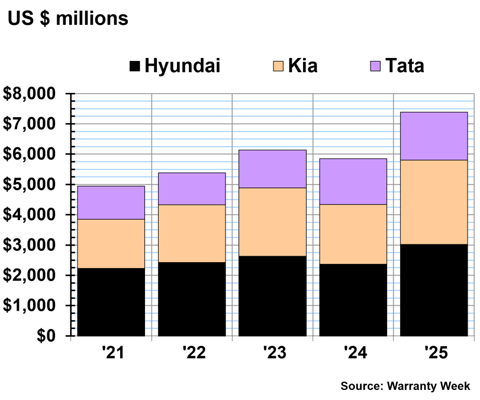
In 2025, Hyundai paid $3.02 billion in warranty claims, an increase of 28% from 2024. This was a new record high, exceeding the previous record set in 2023 amongst the Theta II and ABS recalls.
Kia paid $2.79 billion in warranty claims in 2025, a 42% increase from 2024. Similar to Hyundai, this was a record high for Kia, exceeding the warranty claims costs of 2023.
Tata paid $1.58 billion in warranty claims in 2025, a 4% increase from 2024. Just narrowly, this was a new record high amount of annual warranty claims costs for Tata as well.
Warranty Claims Rates
Figure 2 shows the average annual warranty claims rates for the three automakers, from 2021 to 2025.
Figure 2
Top Korean & Indian Auto Manufacturers
Warranty Claims Rates
(as a percentage of sales, 2021-2025)
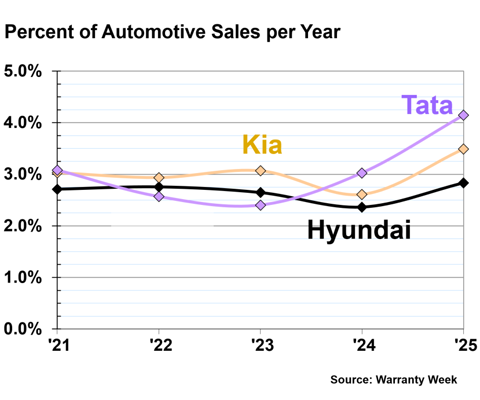
In 2025, Hyundai paid 2.83% of vehicle sales revenue in warranty claims, an increase of about one-quarter from 2024. Kia had a warranty claims rate of 3.49% in 2025, an increase of about one-third from 2024.
Tata had a warranty claims rate of 4.14% in 2025, an increase of about one-third from 2024.
Warranty Accrual Totals
Figure 3 shows the total warranty accruals set aside by the three automakers, from 2021 to 2025.
Figure 3
Top Korean & Indian Auto Manufacturers
Accruals Made per Year
(in billions of U.S. dollars, 2021-2025)
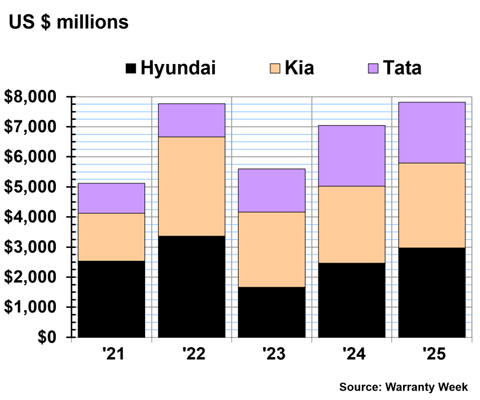
Hyundai set aside $2.97 billion in warranty accruals in 2025, a 21% increase from 2024. Kia set aside $2.82 billion in warranty accruals in 2025, a 10% increase.
Tata set aside $2.03 billion in warranty accruals in 2025, the same amount the automaker set aside in 2024.
Warranty Accrual Rates
Figure 4
Top Korean & Indian Auto Manufacturers
Warranty Accrual Rates
(as a percentage of sales, 2021-2025)
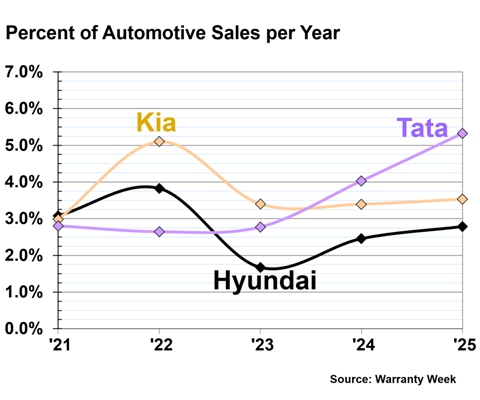
In 2025, Hyundai had a warranty accrual rate of 2.79%, an increase of about one-sixth from 2024. Kia had an accrual rate of 3.53%, a slight increase from 2024.
Tata had a warranty accrual rate of 5.32% in 2025, an increase of one-third from 2024.
Accruals per Vehicle Sold
Global automakers report the number of vehicles they sell each year. Using these figures, along with the total warranty accruals shown in Figure 3, we calculate the average rate of warranty accruals per vehicle sold.
Figure 5 shows the average amount of warranty accruals set aside per vehicle sold by these three automakers, from 2021 to 2025.
Figure 5
Top Korean & Indian Auto Manufacturers
Accruals Made per Vehicle Sold
(in U.S. dollars, 2021-2025)
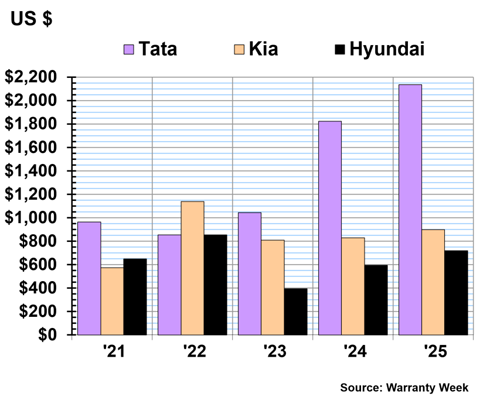
Compared to the two South Korean automakers, Tata sets aside far more per vehicle sold. This is largely influenced by Tata's luxury vehicle brands, such as Jaguar, Land Rover, and Range Rover. In fiscal 2025, Tata set aside an average of $2,134 per vehicle sold, a 17% increase from 2024.
Kia set aside an average of $899 per vehicle sold in 2025, an increase of 8% from 2024. Hyundai set aside an average of $718 per vehicle sold, an increase of 21% from 2024.
Warranty Reserve Balances
Figure 6 shows the total amount of warranty reserves held by each automaker, at the end of their respective fiscal years, from 2021 to 2025.
Figure 6
Top Korean & Indian Auto Manufacturers
Reserves Held at Year's End
(in billions of U.S. dollars, 2021-2025)
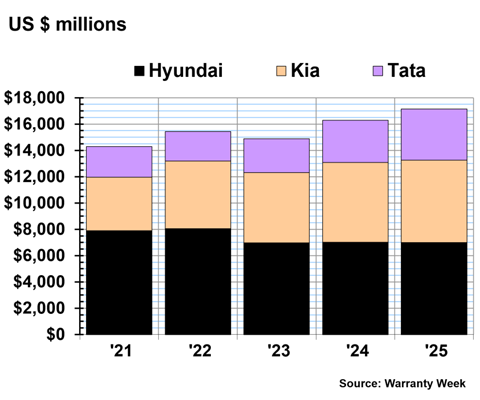
At the end of 2025, Hyundai held $6.99 billion in warranty reserves, a very slight decrease from the end of 2024. Kia held $6.27 billion in warranty reserves at the end of 2025, a slight 3% increase from the end of 2024.
Tata held $3.90 billion in warranty reserves at the end of fiscal 2025, a 21% increase from the end of fiscal 2024.
Check out some more newsletters on the 2025 warranty expenses of worldwide automakers:
- U.S. Auto Warranty Expenses
- European Automaker Warranty Expenses
- Top Japanese Automaker Warranty Expenses
- Mid-Year U.S. Auto Warranty Expenses