


Discrete GPU Warranty Expenses:
From 2024 to 2025, Nvidia saw its warranty claims paid increase by 1000%, its accruals increase by 173%, and its reserve balance increase by 218%. AMD's claims paid increased by 116%, its accruals increased by 68%, and its reserves increased by 76%.
The biggest story from last week's newsletter "Top 100 Warranty Providers of 2025" was the steep and rapid rise in GPU manufacturer Nvidia's warranty expenses. From 2024 to 2025, Nvidia's warranty claims and accrual rates both more than doubled, as did the end-balance of its warranty reserve fund.
Nvidia's close competitor Advanced Micro Devices, or AMD, also saw significant increases in warranty metrics, with its claims rate and warranty reserve end-balance both increasing by two-thirds.
These increases in warranty expenses from the two largest global discrete GPU manufacturers were notable enough to prompt us to take a closer look at the industry this week. What we found is that warranty claims, accruals, and reserves increased by an order of magnitude from 2024 to 2025.
To create this newsletter, we perused the annual reports and quarterly financial statements of Nvidia Corp. and Advanced Micro Devices Inc., and gathered three key warranty metrics: the amount of claims paid, the amount of accruals made, and the end-balance of the warranty reserve fund.
In addition, we gathered data on each manufacturer's product sales revenue, and used these to calculate two additional warranty expense rates: claims as a percentage of revenue (the claims rate), and accruals as a percentage of revenue (the accrual rate).
Discrete GPUs
Every electronic with a screen comes with a built-in central processing unit, or CPU. Typically, CPUs have integrated graphics processing units, or GPUs as part of the larger chip. However, for more complex applications, discrete GPUs, external and separate from the CPU, are preferable.
Discrete GPUs are a specialized type of semiconductor chip featuring many cores, designed to rapidly perform complex calculations and parallel processing, making them ideal for image and video generation. Primary uses of discrete GPUs include artificial intelligence, video gaming, and cryptocurrency mining.
It's important to note that cryptocurrency mining is considered commercial use, and voids the product warranty for Nvidia and AMD discrete GPUs. However, running AI programs is typically considered normal use, depending on the intensity of the AI workload for the GPU. Furthermore, modifying the cards, including custom cooling apparatuses that are popular with video gamers.
Nvidia and AMD have cornered the international market for discrete GPUs. Nvidia held over 90% of the discrete GPU market throughout 2025, according to reports from Jon Peddie Research. AMD held about 7% of the market at the end of 2025.
Intel has attempted to join the discrete GPU market, but continues to primarily deal in CPUs with integrated GPUs. Furthermore, Intel does not publish its warranty expenses in its financial reports, despite being publicly traded.
Other major international players in the discrete GPU industry are the "add-in-card (AIC) partners," which purchase GPU chips from Nvidia or AMD, and design their own graphics cards, boards, and cooling systems. Nvidia's and AMD's AIC partners include ASUS, MSI, Gigabyte, and PowerColor, based in Taiwan; Sapphire and Zotac, based in China; and PNY, based in the United States.
AIC partners offer their own limited warranties, which also cover the integrated chip from Nvidia or AMD. Nvidia and AMD limited warranties cover discrete GPUs used by the end-user, not chips included in larger graphics cards sold by other manufacturers.
In recent months, the prices of discrete GPUs have increased across the market, due to the current random access memory (RAM) shortage. The AI boom has prompted an unprecedented level of sales of chips related to computer memory, including GPUs. The price of RAM quadrupled from mid-2025 to early 2026. This shortage is already driving up prices for electronics using memory chips and integrated GPUs, including computers and game consoles, and is expected to affect mobile phones, smart appliances, medical equipment, and even entertainment systems in vehicles.
We expect that the RAM shortage will also continue to drive up the prices of discrete GPU repairs. As we will see in Figures 1, 3, and 5, the total warranty costs of the top discrete GPU manufacturers increased significantly from 2024 to 2025. At the same time, as we will see in Figures 2 and 4, warranty claims and accruals in proportion to sales revenue, as a percentage, also significantly increased over the same period.
Increased GPU sales explain some of the increases in warranty expenses we will see in the following charts. In addition, the higher warranty expense rates show that the average repair also costs more, due to tariffs and the RAM shortage.
Warranty Claims Totals
Figure 1 shows the total warranty claims paid by Nvidia and AMD per year, from 2003 to 2025.
Figure 1
Top Discrete GPU Manufacturers
Claims Paid per Year
(in millions of U.S. dollars, 2003-2025)
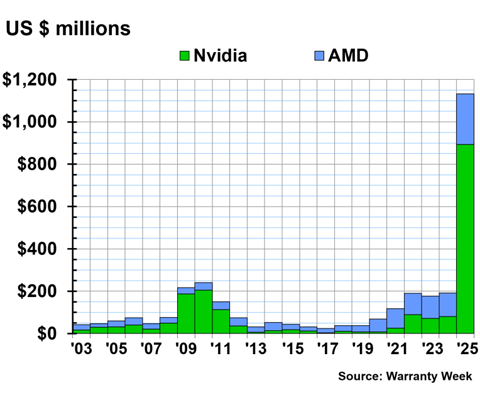
AMD's warranty claims costs doubled from $110 million in 2024, to $238 million in 2025.
Nvidia paid $81 million in warranty claims in 2024, and $894 million in 2025. That's a 1000% increase. Yes, Nvidia paid eleven times more in warranty claims in 2025, compared to 2024.
On a quarterly basis, Nvidia paid $147 million in claims in the first quarter of 2025, $80 million in the second quarter, $156 million in the third quarter. In the fourth quarter of 2025, Nvidia saw a sharp rise in its warranty claims costs, up to $511 million.
The bump in Nvidia's claims costs in 2009 through 2011 was the result of a large-scale recall, when it found that the integrated GPUs it made for Apple, HP, and Dell laptops between May 2007 and September 2008 were defective.
Nvidia's limited warranties for end-users range from one to three years in length. In addition, AIC partners that use Nvidia chips in their graphics cards, such as PNY, offer "warranty extensions" that bring the limited warranty length to five years.
Nvidia also sells extended warranties for a small number of its products. PNY also has an extended warranty program called the "Nvidia RTX Long-Life Program." Furthermore, there are extended warranties for sale for discrete GPUs from online retailers and TPAs, including Micro Center and Best Buy.
Warranty Claims Rates
Figure 2 shows the quarterly warranty claims rates of Nvidia and AMD, from 2021 to 2025.
Figure 2
Top Discrete GPU Manufacturers
Warranty Claims Rates
(as a % of product sales, 2021-2025)
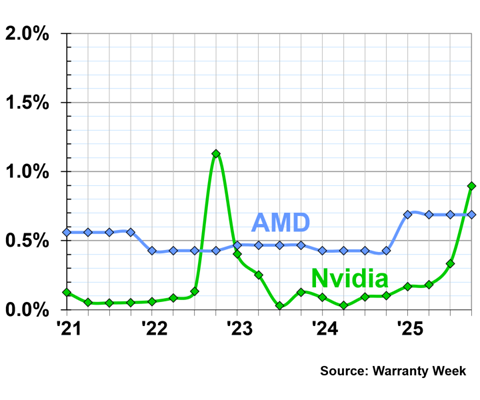
AMD reports its warranty expenses on an annual basis, rather than quarterly. In 2025, AMD had a warranty claims rate of 0.69%. In 2024, AMD had a claims rate of 0.43%; thus, AMD's claims rate increased by two-thirds from 2024 to 2025.
Nvidia had a warranty claims rate of 0.17% in the first quarter of 2025, which rose over the year to 0.90% in the fourth quarter. From the fourth quarter of 2024 to the fourth quarter of 2025, Nvidia's warranty claims rate increased nine-fold.
Warranty Accrual Totals
Figure 3 shows the total warranty accruals made by the top GPU manufacturers, from 2003 to 2025. Note that Figures 1 and 3 are on different y-axis scales, to better illustrate these data.
Figure 3
Top Discrete GPU Manufacturers
Accruals Made per Year
(in millions of U.S. dollars, 2003-2025)
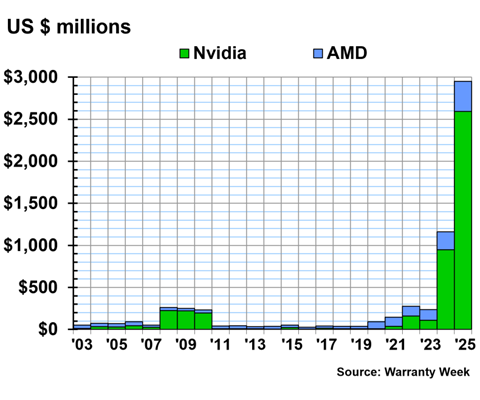
AMD set aside $126 million in warranty accruals in 2023, which increased by two-thirds to $213 in 2024. The next year, AMD increased its warranty accruals by two-thirds once again, up to a total of $358 million in 2025.
In 2023, Nvidia set aside $109 million in warranty accruals, which increased eight-fold to $948 million in 2024. In 2025, Nvidia nearly tripled its total warranty accruals, setting aside a total of $2.59 billion over the year.
On a quarterly basis, Nvidia set aside $428 million in warranty accruals in the first quarter of 2025, $870 million in the second quarter, and $220 million in the third quarter. In the fourth quarter, Nvidia set aside $1.07 billion in warranty accruals.
Warranty Accrual Rates
Figure 4 shows the quarterly warranty accrual rates of the top discrete GPU manufacturers, from 2021 to 2025.
Figure 4
Top Discrete GPU Manufacturers
Warranty Accrual Rates
(as a % of product sales, 2021-2025)
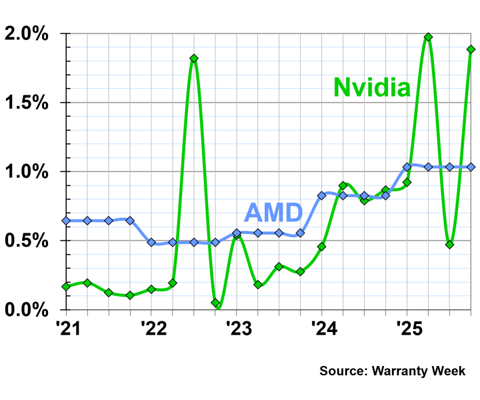
AMD had a warranty accrual rate of 1.03% in 2025, an increase of one-quarter from 2024.
From the fourth quarter of 2024 to the fourth quarter of 2025, Nvidia's accrual rate doubled.
Nvidia had a warranty accrual rate of 0.92% in the first quarter of 2025, which spiked to 1.97% in the second quarter, fell again to 0.47% in the third quarter. The accrual rate tripled to 1.88% in the fourth quarter of 2025. We can see that these fluctuations do map with the quarterly variations we described in Figure 3.
Warranty Reserve Balances
Figure 5 shows the end-balance of Nvidia and AMD's warranty reserve funds, from 2003 to 2025.
Figure 5
Top Discrete GPU Manufacturers
Reserves Held per Year
(in millions of U.S. dollars, 2003-2025)
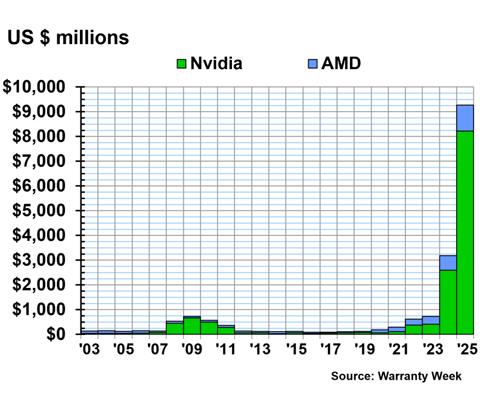
At the end of 2023, Nvidia held $416 million in warranty reserves. The company then sextupled its warranty reserve balance, to $2.59 billion at the end of 2024. Nvidia further tripled its warranty reserve balance in 2025, and held $8.22 billion in the account at the end of the fiscal year.
AMD held $310 million in reserves at the end of 2023, which nearly doubled to $597 at the end of 2024. AMD further increased its warranty reserves by three-quarters, and held $1.05 billion at the end of fiscal 2025.