

Top 100 Warranty Providers of 2025:
40% of the top 100 U.S.-based warranty providers saw significant fluctuations in their warranty expense rates from 2024 to 2025. Lucid Group, Nvidia, and Visteon appeared in the maximum of three charts.
99.8% of U.S.-based manufacturers that provide product warranties have published their 2025 annual reports. This week, we're beginning our series of newsletters analyzing U.S. product warranty expenses. Warranty Week's full data set encompasses over 1,400 manufacturers, across 23 years, three manufacturing sectors, and 18 industry groups.
This week, we're starting with a smaller, key group of manufacturers: the top 100 U.S.-based warranty providers, based on the amount of product warranty claims paid in 2025.
The theory behind the top 100 is, while it would be improper to compare the warranty expense rates of manufacturers of varying sizes across different industries, comparing each manufacturer to itself a year ago, and measuring the magnitude of those changes, is quite revealing.
As always, our results prove that stable warranty expense rates are the norm. 60% of the manufacturers made none of the six top 10 change charts, while 40% appeared on at least one chart. 23 companies were on one list, 14 were on two lists, and just three were on the maximum of three lists.
Methodology
As we do every year, we perused the annual reports of every U.S.-based manufacturer that issues product warranties, and reports those warranty expenses to the United States Securities and Exchange Commission.
From each annual report, we extract three key warranty metrics: the amount of claims paid, the amount of accruals made, and the end-balance of the warranty reserve fund. In addition, we also gathered data on each manufacturer's product sales revenue, meaning just the revenue generated from the sale of products that come with limited warranties attached.
Using these data, we also calculate our two warranty expense rates: claims as a percentage of sales (the claims rate), and accruals as a percentage of sales (the accrual rate).
We standardized each manufacturer's fiscal year to the calendar year, using data from subsequent quarterly financial statements for those whose fiscal year ended before December 31, 2025.
Next, we took our list of over 1,400 manufacturers, and sorted them based on the total amount of warranty claims paid in 2025. We eliminated any manufacturers that reported in 2025, but not in 2024, since we need at least two years of data to create our charts.
In calendar 2025, the top 100 warranty providers each paid at least $24.6 million in warranty claims.
We compiled the top 100 data set in mid-March. Had we waited and compiled the top 100 in early April instead, TPI Composites Inc., which was late filing its annual report, would have made the cut as the 90th largest warranty provider of 2025.
Two companies that made the top 100 in 2024 were acquired in 2025, and thus did not file annual reports. Spirit AeroSystems Holdings Inc., which had been spun-off from Boeing in 2005, was re-acquired by Boeing in December 2025, with some assets transferred to Airbus as part of the transaction. Additionally, iRobot Corp. filed for Chapter 11 bankruptcy in December 2025, following the 2024 collapse of a proposed Amazon acquisition due to European Union antitrust scrutiny. iRobot was quickly acquired by Shenzhen Picea Robotics, its primary contract manufacturer.
For each of the top 100 manufacturers by warranty expenses, we calculated the percent change of the claims rates, accrual rates, and warranty reserve end-balances, from 2024 to 2025. For each metric, we ranked the companies by their rates of change. Figures 1, 3, and 5 show the largest reductions in these metrics, and Figures 2, 4, and 6 show the largest increases.
The Top 100 Warranty Providers
With six charts in this report, three showing reductions and three showing increases, each manufacturer in the top 100 had a maximum of three possible appearances.
Three manufacturers appeared in three charts: Lucid Group Inc., Nvidia Corp., and Visteon Corp. Lucid, the electric vehicle manufacturer majority owned by the Saudi Arabian Public Investment Fund, appeared on two lists in the 2024 top 100, as did the high-profile GPU manufacturer Nvidia. Visteon, an auto parts supplier, appeared in zero charts in the 2024 top 100.
The 14 manufacturers that appeared in two charts were: Advanced Micro Devices Inc., Aptiv plc, Boeing Co., Dana Inc., DexCom Inc., Hyster-Yale Inc., Illumina Inc., Ingersoll Rand Inc., Johnson Controls International plc, Peloton Interactive Inc., Shoals Technologies Group Inc., SolarEdge Technologies Inc., Super Micro Computer Inc., and Vertiv Holdings Co.
The 23 manufacturers that appeared in just one chart were: Acuity Inc., Brunswick Corp., Daktronics Inc., Generac Holdings Inc., General Electric Co. dba GE Aerospace, HP Inc., Lam Research Corp., La-Z-Boy Inc., Malibu Boats Inc., Meritage Homes Corp., Middleby Corp., Oshkosh Corp., Owens Corning, Polaris Inc., PulteGroup Inc., Rivian Automotive Inc., Seagate Technology Holdings plc, Sekisui House US Inc., Standard Motor Products Inc., Tandem Diabetes Care Inc., Thor Industries Inc., Toll Brothers Inc., and Whirlpool Corp.
60 manufacturers appeared in zero charts. Thus, large fluctuations in warranty expense rates are not the norm among the largest product warranty providers.
The following charts show the top 10 manufacturers with the largest reductions or increases in each warranty metric, ranked in order of the magnitude of the changes.
Generally speaking, reductions in expense rates are good news, meaning a company is spending a smaller proportion of total product revenue on warranty, and rate increases are bad news. But, of course, there are exceptions and nuances to this rule of thumb. For instance, it's better to keep expense rates consistently low, rather than see them soar one year and dip the next. Rate reductions can show the aftermath of recalls, and rate increases can reflect increasing parts and labor costs.
Claims Rate Reductions
We'll start off with some good news. The following ten companies saw the largest reductions in their warranty claims rates from 2024 to 2025.
Figure 1
Top 100 U.S.-based Warranty Providers:
Top Ten Claims Rate Reductions,
Calendar Year 2024 vs. 2025
(claims as a % of product sales)
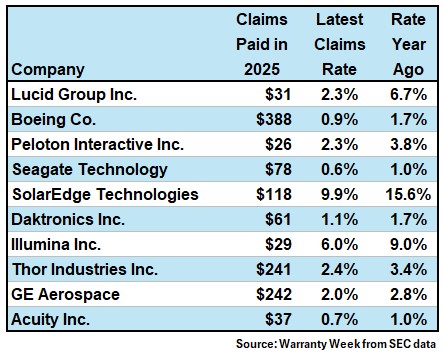
Lucid Group's warranty claims rate decreased by two-thirds from 2024 to 2025. The 2025 claims rate was 2.3%, much closer to the automotive industry norm.
Boeing's warranty claims rate decreased by about two-fifths, down to 0.9%. This demonstrates a notable recovery from the Boeing 737 MAX recalls that plagued the airplane manufacturer in the first half of the 2020s.
Peloton, maker of luxury exercise equipment, also saw its claims rate reduced by about two-fifths, down to 2.3% in 2025.
Seagate, SolarEdge, Daktronics, Illumina, and Thor Industries each saw their claims rates reduced by about one-third from 2024 to 2025.
GE Aerospace, the successor of the former parent General Electric following the spin-off of its power division as GE Vernova, saw its claims rate reduced by about one-third as well.
Claims Rate Increases
Significant increases in the proportion of product revenue spent on warranty are seldom good news. However, note that many of the manufacturers in Figure 2 are relatively new, and rapidly growing, companies, such as Nvidia and Rivian. While the claims rates in Figure 2 increased, none of them are far beyond the norm for their respective industries.
Figure 2 shows the top ten companies with the largest increases in the warranty claims rate from 2024 to 2025.
Figure 2
Top 100 U.S.-based Warranty Providers:
Top Ten Claims Rate Increases,
Calendar Year 2024 vs. 2025
(accruals as a % of product sales)
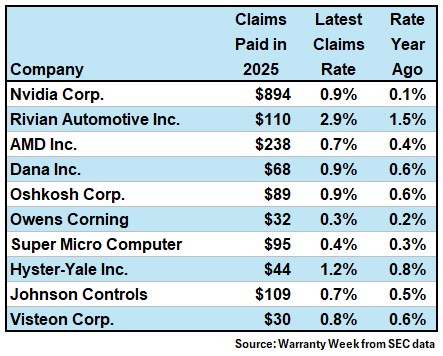
Nvidia saw its claims rate increase eightfold from 2024 to 2025, from 0.1% to 0.9%. Although that's a significant magnitude of increase, 0.9% is still quite a low proportion of product revenue to be spending on warranty. However, it is worth noting that an increasing number of Nvidia's highly sought-after discrete GPUs are being used to power AI, a commercial usage that invalidates the product warranty. Cryptocurrency mining, another common use of Nvidia GPUs, also invalidates the limited warranty.
A shrinking proportion of Nvidia's GPUs are used for powering personal computers, typically for video games, especially in the midst of the current RAM (random-access memory) shortage driving up prices. So, in summation, Nvidia's GPUs are more expensive than ever, and a smaller proportion of them are being used in ways compliant with the terms of the limited warranty, yet the proportion of sales revenue spent of warranty continues to increase.
Nvidia's total warranty claims paid also increased elevenfold over the same period. We will be exploring this story in-depth throughout this series, as we hone in on the warranty expenses of the semiconductor industry.
For similar reasons, fellow GPU manufacturer AMD (Advanced Micro Devices) saw its warranty claims rate increase by about two-thirds, from 0.4% in 2024, to 0.7% in 2025. AMD's total claims paid doubled over the same period.
Rivian saw its warranty claims rate almost double, from 1.5% in 2024 to 2.9% in 2025. Its total warranty claims paid increased by about two-thirds, meaning that a decrease in vehicle sales revenue helped further drive up the claims rate.
Dana and Oshkosh Corp. both saw their claims rates increase by one-half, from 0.6% to 0.9%. Owners Corning, Super Micro Computer, Hyster-Yale, and Johnson Controls also saw their claims rates increase by about one-half.
Visteon saw its claims rate increase by about two-fifths, from 0.6% in 2024 to 0.8% in 2025.
Accrual Rate Reductions
Figure 3 shows the top ten largest warranty accrual rate reductions from 2024 to 2025. This is great news for these manufacturers.
Figure 3
Top 100 U.S.-based Warranty Providers:
Top Ten Accrual Rate Reductions,
Calendar Year 2024 vs. 2025
(accruals as a % of product sales)
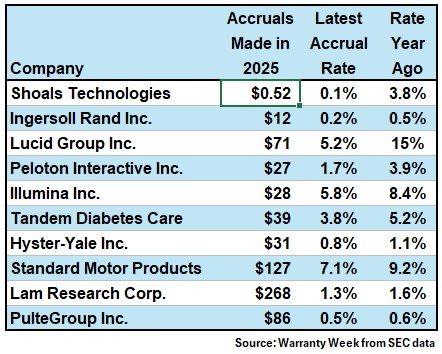
Shoals Technologies, an auto parts supplier, significantly reduced its warranty accrual rate, from 3.8% in 2024 to 0.1% in 2025.
Ingersoll Rand Inc. saw its accrual rate reduced by about three-quarters, from 0.5% to 0.2%.
Lucid Group also saw its accrual rate decrease by three-quarters, from a whopping 14.9% in 2024 to 5.2% in 2025.
Peloton saw its accrual rate cut in half, from 3.9% in 2024 to 1.7% in 2025.
Illumina and Tandem Diabetes Care both reduced their accrual rates by about one-third. Hyster-Yale and Standard Motor Products both decreased their accrual rate by about one-quarter. Lam Research and PulteGroup both decreased their accrual rates by about one-fifth.
Accrual Rate Increases
Figure 4 shows the ten largest warranty accrual rate increases from 2024 to 2025. In years past, we've called this one "the pain chart." Since manufacturers have the most direct control over their warranty accruals, setting aside a significantly larger proportion of sales revenue means warranty costs are soaring, expected to continue to increase, and at risk of spiraling out of control.
Figure 4
Top 100 U.S.-based Warranty Providers:
Top Ten Accrual Rate Increases,
Calendar Year 2024 vs. 2025
(accruals as a % of product sales)
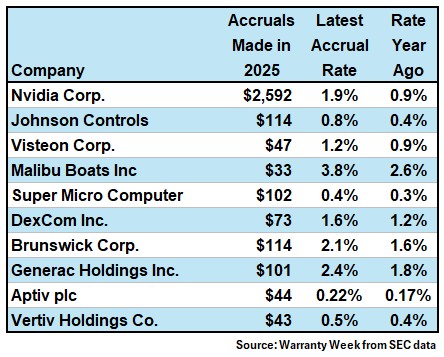
Nvidia more than doubled its warranty accrual rate, from 0.9% in 2024 to 1.9% in 2025. Its total warranty accruals almost tripled over the same period, from $950 million in 2024 to $2.6 billion in 2025.
Johnson Controls doubled its warranty accrual rate, from 0.4% in 2024, to 0.8% in 2025. Notably, Johnson Controls actually set aside the same amount in warranty accruals in both years, $114 million. The change was in the denominator, meaning that expected warranty costs stayed the same while total sales revenue decreased.
Visteon, Malibu Boats, and Super Micro Computer each increased their warranty accrual rates by about one-half. DexCom, Brunswick Corp., Generac, Aptiv, and Vertiv all saw their accrual rates increase by about one-third.
Warranty Reserve Reductions
Figure 5 shows the top ten largest warranty reserve reductions from the end of 2024 to the end of 2025.
Figure 5
Top 100 U.S.-based Warranty Providers:
Top Ten Warranty Reserve Reductions,
Calendar Year 2024 vs. 2025
(accruals as a % of product sales)
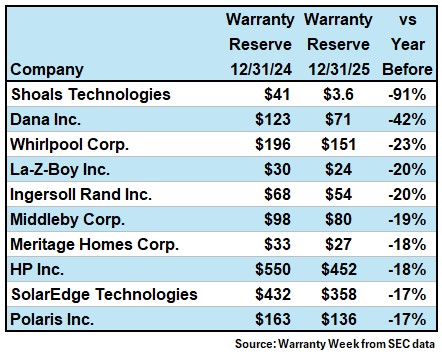
Shoals Technologies significantly reduced the size of its warranty reserve fund, from $41 million at the end of 2024, to just $4 million at the end of 2025. That's a -91% decrease, nearly draining the entire account.
Fellow auto parts supplier Dana cut its warranty reserve fund by -42%, from $123 million at the end of 2024, to $71 million at the end of 2025.
Whirlpool, La-Z-Boy, Ingersoll Rand Inc., Middleby, Meritage, HP, SolarEdge, and Polaris each decreased the size of their warranty reserve funds by about -20%.
Warranty Reserve Increases
Finally, Figure 6 shows the top ten largest warranty reserve balance increases from the end of 2024 to the end of 2025.
Figure 6
Top 100 U.S.-based Warranty Providers:
Top Ten Warranty Reserve Increases,
Calendar Year 2024 vs. 2025
(accruals as a % of product sales)
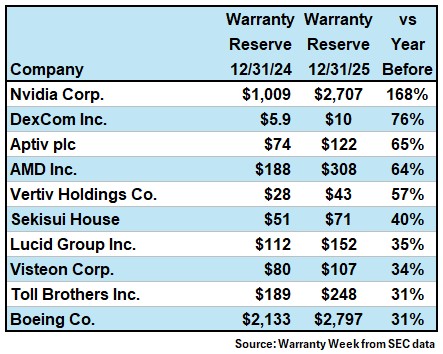
Nvidia more than doubled the size of its warranty reserve fund, from $1.01 billion at the end of 2024, to $2.71 billion at the end of 2025. We can imagine that Nvidia's GPU sales are growing, in both number of units sold and unit prices, at such a rate that it's difficult for the actuaries to predict how much the company will spend on warranty in coming years.
Similarly, AMD increased the size of its warranty reserve fund by two-thirds, from $188 million at the end of 2024, to $308 million at the end of 2025.
Medical device manufacturer DexCom increased the size of its warranty reserve fund by three-quarters, from $6 million at the end of 2024, to $10 million at the end of 2025.
Aptiv increased the size of its warranty reserve fund by two-thirds, from $74 million at the end of 2024, to $122 million at the end of 2025.
Vertiv increased its warranty reserve fund by 57%, from $28 million at the end of 2024, to $43 million at the end of 2025.
Sekisui House, the U.S. branch of the Japanese company that acquired M.D.C. in 2024, increased its warranty reserve fund by 40% under new ownership.
Lucid Group, Visteon, Toll Brothers, and Boeing each increased the size of their warranty reserve funds by about one-third.