

European Automaker Warranty Expenses:
Stellantis almost doubled its warranty accruals from 2024 to 2025, on the back of several large recalls and over €4 billion in changes of estimate.
Since many of our American readers are on holiday, we're taking a small break from our series of 23-year charts of the warranty expenses of U.S.-based manufacturers.
This week, we're taking a look at the 2025 warranty expenses of eight European-based automakers: Volkswagen, Stellantis, Mercedes-Benz, Volvo Cars, BMW, Renault, Ferrari, and Polestar.
European Automakers
Chinese automaker Geely Group acquired Volvo Cars from Ford in 2010, and acquired Polestar in 2015. Both Volvo Cars and Polestar file their own separate annual reports; Volvo reports in Swedish krona, and Polestar reports in U.S. dollars. Both subsidiaries are headquartered in Sweden.
Polestar has been in the news lately, after the U.S. Department of Commerce’s Bureau of Industry and Security decreed that Polestar will not be able to sell vehicles beyond the 2027 model year, due to its Geely Group ownership. Polestar opened a factory in South Carolina in 2024, in an attempt to comply with the former $7,500 EV tax credit. However, the Bureau says that Polestar violates the "Connected Vehicle Rule," which prohibits the U.S. sale of vehicles and technology from China and Russia.
Meanwhile, Polestar is currently offering vehicles for $25,000 off asking price, offloading its remaining stock. The luxury EV OEM says it will continue to operate its existing service centers in the United States. In the first quarter of 2026, only 6% of Polestar's sales were in the United States. The South Carolina factory was already exporting vehicles to Europe, so the future of that operation is currently unknown.
Note that Volvo Cars, also owned by Geely Group, is a separate entity from Volvo Group, which owns the commercial vehicle business Volvo Truck. Ford acquired Volvo Cars in 1999, and then sold it to Geely in 2010. Volvo was able to receive a specific carve-out from the Connected Vehicle Rule.
In 2021, PSA Group (Peugeot Citroën) and FCA (Fiat Chrysler) merged to form Stellantis NV, based in the Netherlands. Stellantis owns passenger vehicle brands including Chrysler, Dodge, Ram, Jeep, Opel, Peugeot, Fiat, Lancia, Citroën, Alfa Romeo, Maserati, and Vauxhall.
Celebrating its fifth year of reporting, Stellantis faced some warranty woes in 2025, which caused accruals and reserves to skyrocket.
FCA owned Ferrari until 2016, when it was spun-off as a separate entity. Ferrari began reporting its warranty expenses in 2019.
Mercedes-Benz has been a pure-play in passenger vehicles since 2022, when it spun-off its substantial commercial vehicle business as Daimler Truck Holding AG.
Volkswagen Group also has a large commercial vehicle business, under its subsidiary Traton SE, parent company of International Motors (formerly Navistar), Scania, and MAN. On the passenger vehicle side, Volkswagen owns Audi and Skoda, along with many luxury brands, including Porche, Lamborghini, and Bentley.
BMW owns Mini and Rolls-Royce, and makes motorcycles as well.
Renault owns Dacia. Furthermore, Renault is a member of the Renault-Nissan, Mitsubishi Alliance, in which each OEM owns a stake of, and has voting power in, the other two automakers. Volvo Group (commercial vehicles) has owned the Renault Trucks brand since 2007.
Note that we do not include data from Jaguar Land Rover in this report, because its expenses are included in the annual report of its parent company, Tata Motors, based in India. Unlike Volvo Cars, Jaguar Land Rover does not report its warranty expenses separate from those of its parent company.
Methodology
To create this newsletter, we perused the annual reports of these eight European automakers, and gathered three key warranty metrics: the amount of claims paid, the amount of accruals made, and the end-balance of the warranty reserve fund.
In addition, we collected two sales metrics from each automaker: the amount of automotive product revenue, and the number of vehicles sold.
Using these data, we calculated three additional warranty metrics: claims as a percentage of sales (the claims rate), accruals as a percentage of sales (the accrual rate), and the amount of accruals per vehicle sold (accruals divided by unit sales).
Volkswagen, Stellantis, Mercedes-Benz, BMW, Renault, and Ferrari all report in Euro. Volvo Cars reports in Swedish kronor (SEK), and Polestar reports in U.S. dollars. For Volvo Cars, we first converted the totals in Swedish kronor into U.S. dollars, using the IRS Yearly average currency exchange rates table. Then, we converted the U.S. dollar amounts for Volvo Cars and Polestar into Euro, using the same exchange rate table.
Warranty Claims Totals
Figure 1 shows the total warranty claims paid by eight European automakers, from 2021 to 2025.
Figure 1
Warranty Claims Paid by
European Automakers
(in EU € millions, 2021-2025)
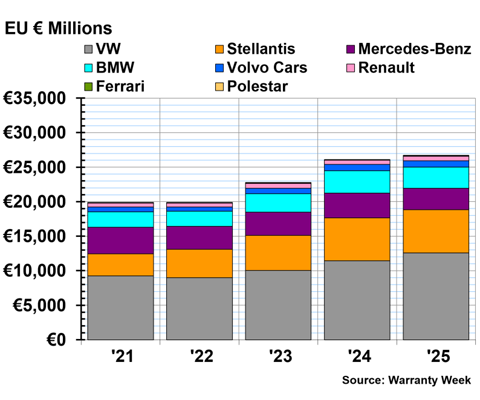
Volkswagen paid €12.59 billion in warranty claims in 2025, a 10% increase from 2024. Stellantis paid €6.26 billion in claims in 2025, a 1% increase.
Mercedes-Benz paid €3.09 billion in warranty claims in 2025, a -15% decrease from 2024. BMW paid €3.07 billion in claims in 2025, a -5% decrease.
Volvo Cars paid €912 in warranty claims in 2025, a 5% increase. Renault paid €654 million in claims in 2025, a 7% increase. Polestar paid €64 million in claims, a 68% increase. Ferrari paid $59 million in claims, a -4% decrease.
Warranty Claims Rates
Figure 2 shows the annual warranty claims rates of the European automakers, from 2021 to 2025.
Figure 2
Warranty Claims Rates of
European Automakers
(as a % of product revenue, 2021-2025)
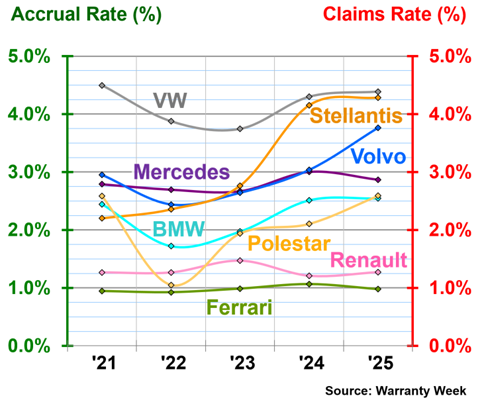
Volvo Cars saw its claims rate increase by one-quarter, from 3% in 2024 to 3.76% in 2025. Polestar had a claims rate of 2.59% in 2025, also an increase of one-quarter.
Aside from Volvo Cars and Polestar, the European automakers all saw their warranty claims rates stay about the same from 2024 to 2025.
Stellantis saw its claims rate plateau in 2025 after a sharp rise in 2024. In 2025, Stellantis had a warranty claims rate of 4.29%.
In 2025, Volkswagen had a claims rate of 4.39%. Mercedes-Benz had a warranty claims rate of 2.87%. BMW had a claims rate of 2.54%. Renault had a claims rate of 1.27%. Ferrari had a claims rate of 0.98%.
Warranty Accrual Totals
Figure 3 shows the total warranty accruals made by the European automakers, from 2021 to 2025.
Figure 3
Warranty Accruals Made by
European Automakers
(in EU € millions, 2021-2025)
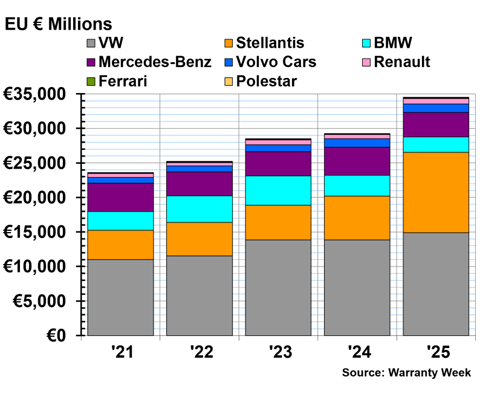
Stellantis set aside €11.65 billion in warranty accruals in 2025, an 84% increase from 2024. This figure includes €4.56 billion in changes of estimate, which are, according to Stellantis' 2025 annual report, "resulting from the reassessment of the estimation process, taking into account recent increases in cost inflation and a deterioration in quality, as a result of operational choices, which did not deliver the expected quality performance."
This is a staggering admission from Stellantis. Stellantis' total warranty accruals increased by 84%, or €5.31 billion, from 2024 to 2025. The annual report also states that the change in accounting increased warranty accruals for vehicles sold in 2025, along with the changes of estimate to previous accruals.
Later in Stellantis' 2025 annual report states,
"In 2025, we decided to recall approximately 13.4 million vehicles. [...] Product recalls may also harm our reputation, force us to halt the sale of certain vehicles and cause consumers to question the safety or reliability of our products. Given the intense regulatory activity across the automotive industry, ongoing compliance costs are expected to remain high."
Furthermore, the annual report states,
"During the year ended December 31, 2025, the Company experienced increased volatility in warranty expenditures, particularly in North America and Enlarged Europe, driven by factors including cost inflation, quality issues associated with new powertrains and platforms, and the impact of prior operational decisions.
The previously applied model for estimating future warranty expenditures was assessed to be insufficiently responsive to rapid changes in experience. Accordingly, during 2025 the Company implemented an updated actuarial model incorporating refined trend development, inflation assumptions and correlations, resulting in greater responsiveness to recent warranty experience."
In early June 2026, Stellantis announced a recall of another 1.3 million vehicles, so it seems that the OEM's warranty woes are not quite over yet.
Volkswagen set aside €14.90 billion in warranty accruals in 2025, a 7% increase from 2024.
Mercedes-Benz set aside €3.56 billion in warranty accruals in 2025, -13% decrease. BMW set aside €2.22 billion in accruals in 2025, a -26% decrease. Volvo Cars set aside about €1.24 billion, a 4% increase.
Renault set aside €789 million in warranty accruals in 2025, a 35% increase from 2024. Polestar set aside €96 million, a 45% increase. Ferrari set aside €68 million, a -27% decrease.
Warranty Accrual Rates
Figure 4 shows the annual warranty accrual rates of the European automakers, from 2021 to 2025.
Figure 4
Warranty Accrual Rates of
European Automakers
as a % of product revenue, 2021-2025)
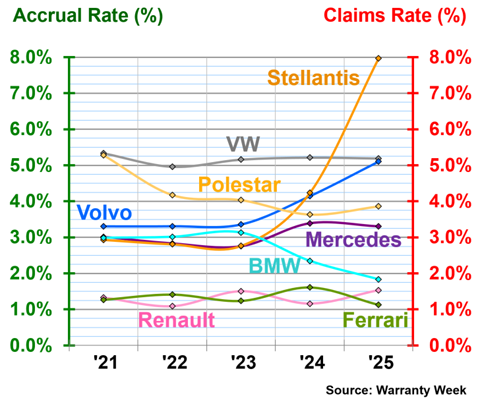
Unsurprisingly, Stellantis also saw its warranty accrual rate almost double, from 4.2% in 2024 to 7.97% in 2025.
Volvo Cars had a warranty accrual rate of 5.11% in 2025, an increase of about one-quarter from 2024. Renault had an accrual rate of 1.53%, an increase of about one-third.
BMW had a warranty accrual rate of 1.84% in 2025, a decrease of about one-quarter from 2024. Ferrari had an accrual rate of 1.13%, a decrease of about one-third.
Volkswagen had a warranty accrual rate of 5.19% in 2025, about the same as the year prior. Mercedes-Benz had an accrual rate of 3.30% in 2025, also the same as the year prior. Polestar had an accrual rate of 3.86% in 2025, a slight increase.
Accruals per Vehicle Sold
Figure 5 shows the total amount of warranty accruals made by each vehicle, divided by the number of vehicles sold per year, as an average in U.S. dollars. Figure 5 shows accruals per vehicle sold for the European automakers, from 2021 to 2025.
Figure 5
Warranty Accruals Made per Vehicle Sold by
European Automakers
(in EU € euro, 2021-2025)
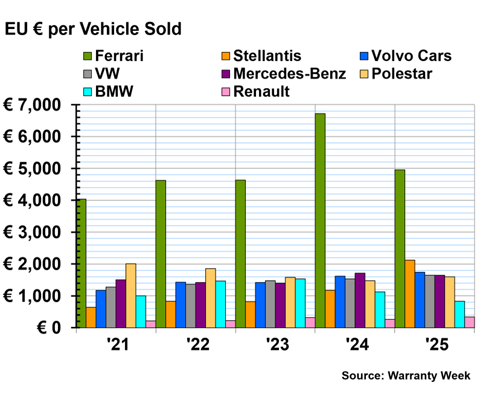
Stellantis set aside an average of €2,123 per vehicle sold in 2025, an 82% increase from 2024's average of €1,170 per vehicle.
Ferrari set aside an average of €4,957 per vehicle sold. This is unsurprising for a luxury vehicle brand, with higher vehicle prices, along with higher parts, repair, and maintenance costs.
Volvo Cars set aside an average of €1,743 per vehicle sold in 2025, a 12% increase from 2024. Volkswagen set aside an average of €1,651 per vehicle sold, an 8% increase. Mercedes-Benz set aside €1,646 per vehicle sold, a -4% decrease. Polestar set aside an average of €1,597 per vehicle, an 8% increase.
BMW set aside an average of €831 per vehicle sold in 2025, a -26% decrease from 2024. Renault set aside an average of €338 per vehicle sold, a 30% increase.
Warranty Reserve Totals
Figure 6 shows the end-balances of each European automaker's warranty reserve fund, from 2021 to 2025.
Figure 6
Warranty Reserves Held by
European Automakers
(in EU € millions, 2021-2025)
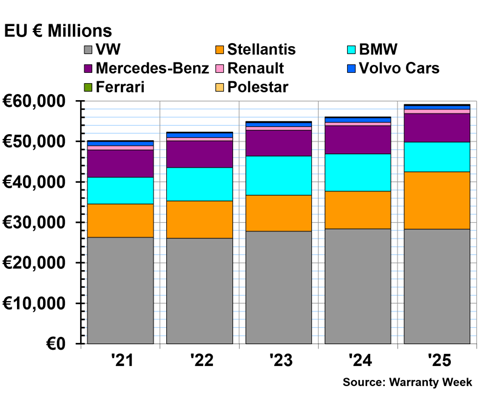
At the end of 2025, Volkswagen held €28.35 billion in warranty reserves, a very slight -0.1% decrease from 2024. Stellantis held €14.12 billion in warranty reserves at the end of 2025, a 52% increase from the end of 2024.
Mercedes-Benz held €7.09 billion in warranty reserves at the end of 2025, a 2% increase. BMW held €7.37 billion in warranty reserves at the end of 2025, a -20% decrease.
Renault held €1.01 billion in warranty reserves at the end of 2025, a 17% increase from the end of the year prior. Volvo Cars held €889 million in warranty reserves, a -13% decrease. Polestar held €144 million in reserves, a 21% increase. Ferrari held €137 million in warranty reserves at the end of 2025, a -10% decrease.