

U.S. Passenger Vehicle Warranty Expenses:
In 2025, the Cars & Cycles industry group paid a total of $13.4 billion in warranty claims, up 8%, set aside $14.9 billion in warranty accruals, up 3%, and held $40.6 billion in warranty reserves, up 25%. That's the third year in a row that all three metrics increased.
Last week, we presented our "23rd Annual Product Warranty Report." This week, we're commencing our series delving into the warranty expenses of the over 1,400 U.S.-based manufacturers, grouped into 18 industries.
We're starting with the vehicle sector, which is comprised of four industry groups. Based on data reported to the SEC, the vehicle sector comprised 69% of all U.S. product warranty claims paid in 2025, 65% of all warranty accruals made, and 78% of all warranty reserves held.
We are beginning this series with the Cars & Cycles industry, which is our shorthand name for the makers of vehicles the size of a pick-up truck or smaller. This industry includes manufacturers of passenger vehicles, vans, boats, ATVs, golf carts, motorcycles, forklifts, snowmobiles, riding lawn mowers, and even street sweeper vehicles.
As we mentioned above, the Cars & Cycles industry set record highs for all three key warranty metrics in 2025, for the third year in a row. We especially saw dramatic increases in the warranty reserve balances of the three largest U.S.-based automakers.
The anticlimactic, yet fascinating, truth is that there wasn't one big event, problem, or recall leading to these rising warranty costs across the industry. Contributing factors include tariffs affecting parts and materials costs, parts and labor shortages, and U.S. dollar inflation. Since warranty reserves were particularly affected, we can assume that manufacturers anticipate costs to continue to rise, prompting them to grow their dedicated "rainy day fund," so to speak, for future warranty costs.
We identified 37 manufacturers in the Cars & Cycles industry, of which 18 reported product warranty expenses in 2025. The three largest companies were Ford Motor Co., General Motors Co., and Tesla Inc.
We also collected 2025 product warranty data from: Rivian Automotive Inc., Polaris Inc., Toro Co., Lucid Group Inc., Harley-Davidson Inc., Malibu Boats Inc., Hyster-Yale Inc., Alamo Group Inc., Federal Signal Corp., MasterCraft Boat Holdings Inc., Marine Products Corp., Twin Vee PowerCats Co., Art's-Way Mfg. Co. Inc., Faraday Future Intelligent Electric Inc., and StableX Technologies Inc.
To create this newsletter, we perused the annual reports and quarterly financial statements of the U.S.-based small vehicle manufacturers, and gathered three key warranty metrics: the amount of claims paid, the amount of accruals made, and the end-balance of the warranty reserve fund.
In addition, we gathered data on each manufacturer's product sales revenue, and used these to calculate two warranty expense rates: claims as a percentage of sales (the claims rate), and accruals as a percentage of sales (the accrual rate).
We did a deep dive into the 2025 warranty expenses of Ford, GM, Tesla, and Rivian in our March 12, 2026 newsletter "U.S. Auto Warranty Expenses." Thus, we will not dwell on the recalls, warranty news, or costs related to the American automakers in this newsletter. You may also take a look at our September 11, 2025 newsletter "Mid-Year U.S. Auto Warranty Expenses" for more detail on the first two quarters of the year.
Warranty Claims Totals
Figure 1 shows the total warranty claims paid by the U.S.-based passenger and small vehicle manufacturers, from 2003 to 2025.
Figure 1
U.S.-based Auto Manufacturers
Claims Paid per Year
(in millions of U.S. dollars, 2003-2025)
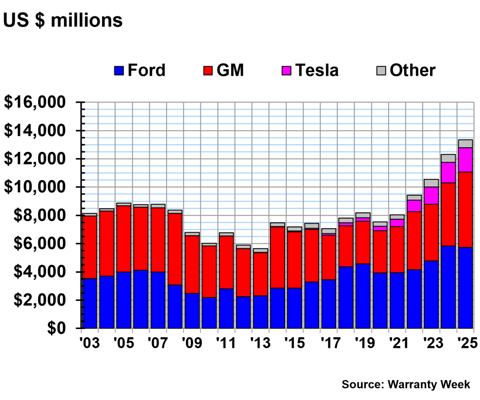
Ford paid $5.73 billion in warranty claims in 2025, a -2% decrease from 2024. GM paid $5.32 billion in claims, a 19% increase. Tesla paid $1.72 billion, a 19% increase.
Fellow electric vehicle manufacturer Rivian paid $110 million in claims in 2025, a 62% increase. Lucid Group paid $31 million, a -42% decrease.
Polaris, maker of ATVs, snowmobiles, and beyond, paid $163 million in warranty claims in 2025, a -11% decrease from 2024. Toro, maker of lawn mowers and utility vehicles, paid $97 million, a 10% increase.
Motorcycle maker Harley-Davidson paid $60 million in warranty claims in 2025, a -6% decrease. Forklift maker Hyster-Yale paid $44 million in claims, a 29% increase.
Malibu Boats paid $29 million in claims in 2025, an 8% increase from 2024. MasterCraft Boat paid $8 million, a -35% decrease from 2024. Marine Products paid $4 million in claims, a 1% increase.
Alamo Group, maker of lawn mowers and utility vehicles, paid $16 million in warranty claims in 2025, a 2% increase. Federal Signal, maker of street sweepers, emergency vehicle equipment, and power washers, paid $7 million in claims, an -18% decrease.
Warranty Accrual Totals
Figure 2 shows the total warranty accruals set aside by the Cars & Cycles manufacturers, from 2003 to 2025.
Figure 2
U.S.-based Auto Manufacturers
Accruals Made per Year
(in millions of U.S. dollars, 2003-2025)
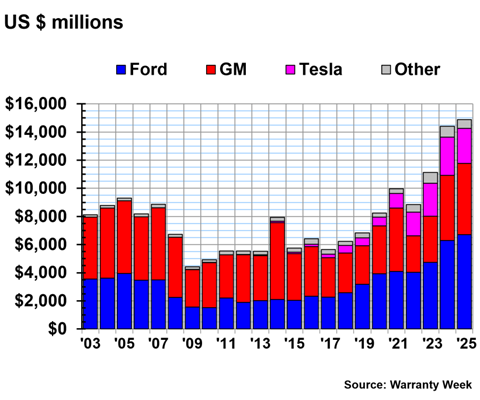
Ford set aside $6.71 billion in warranty accruals in 2025, a 7% increase from 2024. GM set aside $5.07 billion in accruals, a 10% increase. Tesla set aside $2.49 billion in accruals, a -9% decrease.
Rivian set aside $184 million in warranty accruals in 2025, a -30% decrease from the year prior. Lucid set aside $71 million in accruals, a -41% decrease.
Polaris set aside $136 million in warranty accruals in 2025, a -18% decrease from 2024. Toro set aside $88 million in accruals, a 14% increase. Harley-Davidson set aside $43 million in accruals, a -9% decrease.
Malibu Boats set aside $33 million in accruals, a 53% increase. This was the largest amount of annual warranty accruals we've seen Malibu Boats set aside since it started reporting its product warranty expenses in 2015. The company did not provide a special explanation of this rather steep increase in its warranty accruals in its 10-K or 10-Q financial reports.
We did note that Malibu Boats is in some legal trouble related to warranty, although these issues are unlikely to affect product warranty accruals. In its 10-K report, the company notes, "During fiscal year 2023, we settled certain product liability matters for $100.0 million after a jury found that our subsidiary, Malibu Boats, LLC, and another entity that was the manufacturer of the boat at issue, Malibu Boats West, Inc., negligently failed to warn of a hazard posed by the boat and that such failure was a proximate cause of the death of a passenger in the boat."
In addition, Malibu Boats is currently facing a class action lawsuit. As stated in the company's 10-K report, "The complaint, which purports to be filed on behalf of a nationwide class of customers, alleges violation of common law, the Magnuson-Moss Warranty Act, breach of express warranty, breach of implied warranty, and violation of California’s Consumer Legal Remedies Act based on guidance issued to customers of certain older model boats related to riding in the bow area of those boats."
Fellow boat manufacturer MasterCraft Boat set side $7 million, a -2% decrease. Marine Products set aside $4 million, a 5% increase.
Hyster-Yale set aside $31 million in warranty accruals in 2025, a -33% decrease from the year prior. Alamo Group set aside $16 million, a 7% increase. Federal Signal set aside $7 million, a -17% decrease.
Warranty Expense Rates
Figure 3 shows the average quarterly warranty claims and accrual rates for the Cars & Cycles industry, from 2003 to 2025.
Figure 3
U.S.-based Auto Manufacturers
Average Claims and Accrual Rates
(as a % of product sales, 2003-2025)
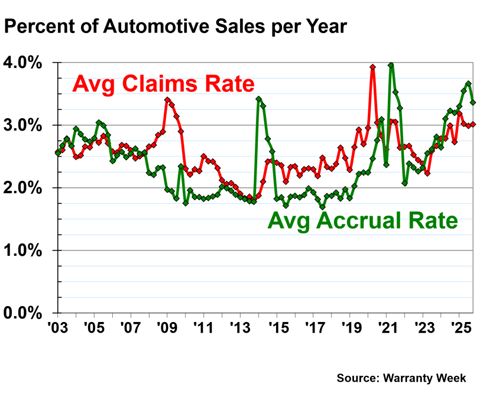
We are lucky to have an expansive data set at Warranty Week, which spans back to 2003. Over 23 years, the Cars & Cycles industry had an average warranty claims rate of 2.56%, with a standard deviation of 0.36%, and an average accrual rate of 2.39%, with a standard deviation of 0.54%.
We can see in Figure 3 that both average warranty expense rates have been trending upward for the last few years. That means that on average, the Cars & Cycles manufacturers have been spending a larger-than-usual amount of their revenue from product sales on warranty. For the claims rate, rising parts and labor costs, along with tariffs more recently, contributed to this increase. For the accrual rate, the emergence of a new wave of EV manufacturers, which tend to over-accrue funds out of caution, explains some, but not all, of this increase.
In 2025, the quarterly warranty claims rates ranged from 2.99% in the third quarter, to 3.19% in the first quarter. The quarterly accrual rates ranges from 3.30% in the first quarter, to 3.66% in the third quarter.
Warranty Reserve Balances
Figure 4 shows the amount of warranty reserves held by the manufacturers in the Cars & Cycles industry at the end of each calendar year, from 2003 to 2025.
Figure 4
U.S.-based Auto Manufacturers
Reserves Held per Year
(in millions of U.S. dollars, 2003-2025)
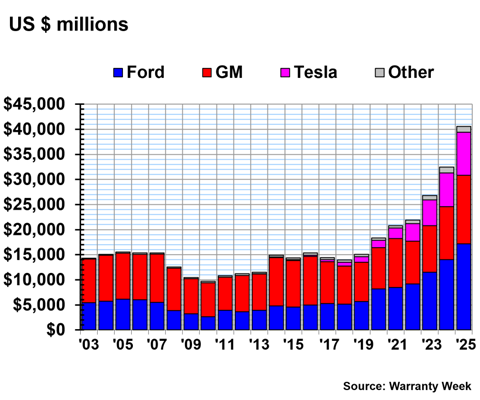
At the end of 2025, the three largest U.S.-based automakers all set new records for the highest warranty reserve end-balances. Ford held $17.19 billion in warranty reserves at the end of 2025, a 23% increase from the end of 2024. GM held $13.63 billion in reserves, a 29% increase from the year prior. That's over $3 billion deposited into the warranty reserves of these two automakers.
Tesla held $8.61 billion in warranty reserves at the end of 2025, a 28% increase. Tesla added nearly $2 billion into its warranty reserves in 2025.
Rivian held $463 million in warranty reserves at the end of 2025, a -2% decrease from the end of 2024. Lucid Group held $152 million in reserves, a 35% increase.
Toro held $152 million in reserves at the end of 2025, a 1% increase. Polaris held $136 million in warranty reserves, a -17% decrease. Hyster-Yale held $74 million in reserves, a -16% decrease. Harley-Davidson held $73 million, a 2% increase.
Malibu Boats held $40 million in warranty reserves at the end of 2025, a 12% increase. MasterCraft Boat held $25 million, unchanged from the end of the year prior. Marine Products held $6 million, a 1% increase.
Alamo Group held $10 million in warranty reserves at the end of 2025, unchanged from the end of 2024. Federal Signal held $12 million, a 22% increase.