

Other U.S. Product Warranties:
Some product warranties defy categorization. This week, we're looking at the limited warranty expenses attached to vapes, e-cigarettes, golf clubs, exercise equipment, jewelry, surveillance cameras, riot gear, water management infrastructure, oil and gas pipelines, hazardous site investigation robots, and more.
This week, we're concluding our newsletter series that began in April with the "23rd Annual Product Warranty Report." Over the last five months, we've done deep dives into the product warranty expenses of the U.S.-based manufacturers in 18 industries. Three industries remain: material handling, security, and sports.
Material handling includes manufacturers that deal with infrastructure, and specialized systems for controlling, compressing, manipulating and transporting water, waste, and oil and gas. Security includes manufacturers of policing and surveillance equipment. Sports includes makers of a wide variety of recreational equipment, and a few manufacturers that defied neat categorization.
Overall, we identified 111 U.S.-based manufacturers we had yet to feature in this year's newsletter series. 51 were material handling manufacturers, 28 were in security, and 32 were in sports.
Material Handling
Of the 51 U.S.-based material handling manufacturers, 14 reported warranty expenses in 2025. The largest were: Xylem Inc., Flowserve Corp., Mueller Water Products Inc., Ingersoll Rand Inc., Lindsay Corp., and Idex Corp.
The Ingersoll Rand Inc. we're discussing in this newsletter is a different company from the former Ingersoll-Rand plc. In early 2020, Gardner Denver Holdings Inc. acquired Ingersoll-Rand plc's industrial segment in a Reverse Morris Trust transaction. The former Ingersoll-Rand plc, left with its HVAC and refrigeration business, renamed itself Trane Technologies plc, while the former Gardner Denver Holdings Inc. renamed itself Ingersoll Rand Inc.
Security
The security industry consists of manufacturers of firearms, security systems, and robots. Many are also police and/or military contractors, making police robots, surveillance equipment, body cameras, weapons, riot gear, tactical gear, etc. Some security manufacturers also dip into the consumer electronics industry, such as surveillance camera doorbells, baby monitors, home security cameras, and robotic vacuums. Furthermore, some make equipment for investigating and mitigating hazardous sites, such as respirators, gas masks, and firefighter equipment.
Of the 28 U.S.-based security equipment manufacturers, nine reported warranty expenses in 2025. The largest were: MSA Safety Inc., Allegion plc, Axon Enterprise Inc., iRobot Corp., and Smith & Wesson Brands Inc.
iRobot Corp. filed for Chapter 11 bankruptcy in December 2025, and was quickly acquired by Shenzhen Picea Robotics, the Chinese company that owns the factories used to manufacture iRobot's Roomba vacuum cleaners.
Smith & Wesson re-branded as American Outdoor Brands Inc. in 2016. In 2020, American Outdoor Brands split into two separate companies, Smith & Wesson Brands Inc. and American Outdoor Brands Inc. both of which report warranty expenses.
Axon Enterprise was known as Taser International Inc. until 2017. Axon re-branded in order to de-emphasize its eponymous weapon, and focus more on surveillance camera products, including body cameras and dashboard cameras.
Sports
The "sports" industry includes many manufacturers of recreational equipment, including elliptical machines, treadmills, camping gear, golf clubs, swimming pools, skis, and bicycles. There are also manufacturers in this industry making equipment for a wider range of "hobbies," including crafting machines, vapes, cannabis cultivation equipment, jewelry, and even stock ticker displays for national stock markets.
Of the 32 U.S.-based sports manufacturers, 13 reported warranty expenses in 2025. The largest were: Philip Morris International Inc., Peloton Interactive Inc., Johnson Outdoors Inc., Acushnet Holdings Corp., YETI Holdings Inc., Latham Group Inc., and Signet Jewelers Ltd.
Philip Morris International Inc. is a U.S.-based company, but only engages in business outside of the United States (Philip Morris USA, a subsidiary of Altria Group, does business in the U.S.). Phillip Morris International (PMI) is responsible for the Marlboro brand outside of the United States. PMI was spun-off from Altria in 2008.
PMI, like much of the cigarette industry, is pivoting to "smoke-free nicotine products," including the Zyn brand of nicotine pouches, the Iqos brand of heated tobacco products, and the Veev brand of electronic cigarettes. In 2023, Iqos surpassed Marlboro as the PMI brand that generated the most revenue, and all of those vapes and heating apparatuses come with limited warranties attached.
While we assume that most vapes sold in the U.S. come with a limited product warranty attached (if not the disposable ones, definitely the reusable ones), PMI is the only U.S.-based Big Tobacco manufacturer that currently reports its warranty expenses.
Peloton makes the eponymous high-end exercise equipment. Johnson Outdoors makes scuba diving gear, and camping equipment such as tents and camp stoves. Acushnet makes golf balls and clubs. Yeti makes coolers and insulated cups. Latham Group makes in-ground residential swimming pools. Signet Jewelers owns the Jared and Kay jewelry brands.
Bowflex was renamed from Nautilus Inc. in 2023, and made exercise equipment. The company filed for Chapter 11 bankruptcy in March 2024, and was subsequently acquired by the Taiwanese exercise equipment manufacturer Johnson Health Tech Co. Ltd.
In late 2024, Vista Outdoor Inc. split into two entities. Its firearm and ammunition brands, including Remington, were acquired by Czechoslovak Group in November 2024, and its outdoor products business was acquired by Strategic Value Partners in January 2025.
Methodology
For each manufacturer, we perused their annual reports and quarterly financial statements, and gathered three key warranty metrics: the amount of claims paid, the amount of accruals made, and the end-balance of the warranty reserve fund.
In addition, we gathered data on each manufacturer's total product sales revenue, and used these to calculate our two warranty expense rates: claims as a percentage of sales (the claims rate), and accruals as a percentage of sales (the accrual rate).
Warranty Claims Totals
Figure 1 shows the total warranty claims paid by U.S.-based manufacturers in the three industry groups, from 2003 to 2025.
Figure 1
Other Product Warranties by Industry
Claims Paid by U.S.-based Manufacturers
(in US$ millions, 2003-2025)
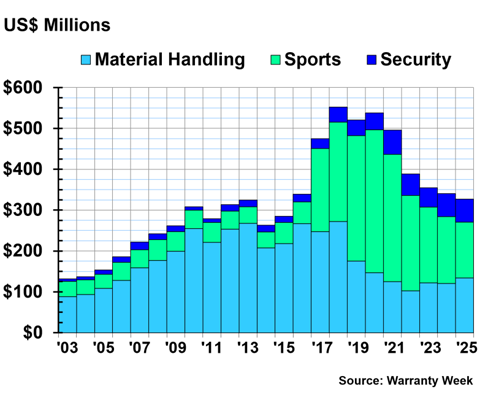
In 2025, the U.S.-based material handling industry paid $134 million in warranty claims, an 11% increase from 2024.
Ingersoll Rand paid $35 million in warranty claims in 2025, a 13% increase from 2024. Xylem paid $34 million in warranty claims in 2025, a -8% decrease. Flowserve paid $18 million in warranty claims in 2025, a -17% decrease from 2024.
Idex paid $14 million in warranty claims, a 237% increase from 2024's total of $4 million. Mueller Water Products paid $13 million in claims in 2025, an 83% increase from 2024. Lindsay Corp. paid $9 million in claims, an 11% increase.
The U.S.-based security industry paid $57 million in warranty claims in 2025, a 1% increase from 2024.
iRobot paid $16 million in warranty claims in 2025, a -21% decrease from 2024. MSA Safety paid $15 million in claims, a 28% increase. Allegion paid $12 million in claims, a -7% decrease. Axon Enterprise paid $9 million in claims, a 51% increase.
The U.S.-based sports equipment manufacturers paid $136 million in warranty claims in 2025, a -17% decrease from 2024.
Philip Morris International (PMI) paid $64 million in warranty claims in 2025, a -27% decrease from 2024. Peloton paid $26 million in claims in 2025, a -28% decrease.
Johnson Outdoors paid $10 million in warranty claims in 2025, a -6% decrease. Signet Jewelers paid $9 million in claims, a -19% decrease. Acushnet paid $7 million in claims, a 4% increase. Yeti paid $7 million in claims, a 26% increase.
Warranty Accrual Totals
Figure 2 shows the total warranty accruals made by the U.S.-based manufacturers in the material handling, sports, and security industries, from 2003 to 2025.
Figure 2
Other Product Warranties by Industry
Accruals Made by U.S.-based Manufacturers
(in US$ millions, 2003-2025)
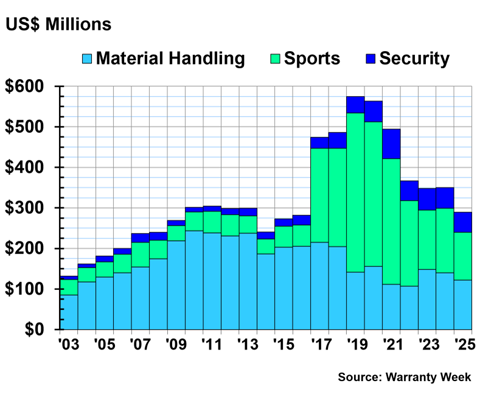
In 2025, the U.S.-based material handling industry set aside $122 million in warranty accruals, a -13% decrease from 2024.
Xylem set aside $39 million in warranty accruals in 2025, an 8% increase from 2024. Flowserve set aside $23 million in warranty accruals in 2025, a -12% decrease. Mueller Water Products set aside $15 million in accruals, a 11% increase.
Ingersoll Rand set aside just $12 million in warranty accruals in 2025, a -69% decrease from 2024. Lindsay set aside $10 million in warranty accruals in 2025, a 25% increase. Idex set aside $8 million in accruals, a 61% increase.
The U.S.-based security industry set aside $49 million in warranty accruals in 2025, a -4% decrease from 2024.
MSA Safety set aside $13 million in warranty accruals in 2025, a 21% increase from 2024. Allegion set aside $13 million in accruals, a -18% decrease.
Axon Enterprise set aside $12 million in warranty accruals in 2025, double its 2024 accruals. iRobot set aside $7 million in 2025, down -49%, before declaring bankruptcy.
The U.S.-based sports manufacturers set aside $118 million in warranty accruals in 2025, a -26% decrease from 2024.
PMI set aside $54 million in warranty accruals in 2025, a -29% decrease from 2024. Peloton set aside $27 million, a -24% decrease.
Johnson Outdoors set aside $10 million in warranty accruals, a -12% decrease. Acushnet set aside $8 million, a 16% increase. Yeti set aside $7 million, a 28% increase.
Warranty Expense Rates
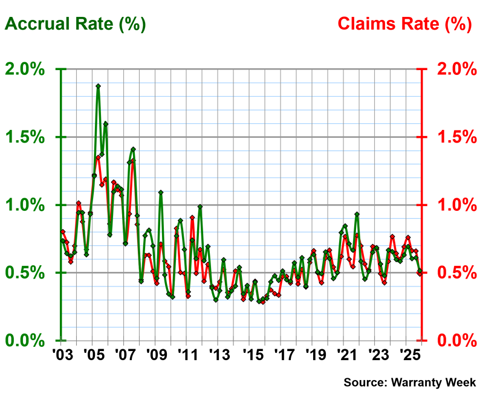
Figure 3 shows the average quarterly warranty expense rates for the U.S. material handling industry, from 2003 to 2025.
Figure 3
U.S. Material Handling Equipment Manufacturers
Average Warranty Claims & Accrual Rates
(as a % of product sales, 2003-2025)
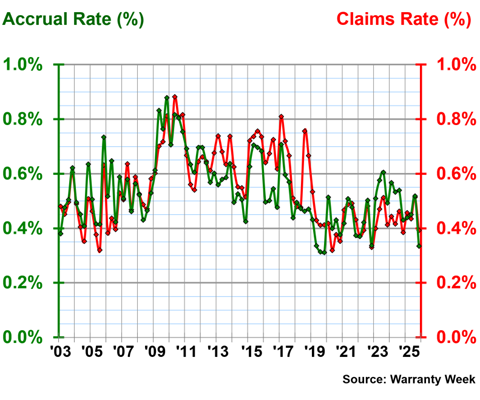
Over 23 years, the U.S.-based material handling industry had an average warranty claims rate of 0.55%, with a standard deviation of 0.14%, and an average warranty accrual rate of 0.54%, with a standard deviation of 0.12%.
In 2025, the material handling industry had an average warranty claims rate of 0.45%, and an average warranty accrual rate of 0.44%.
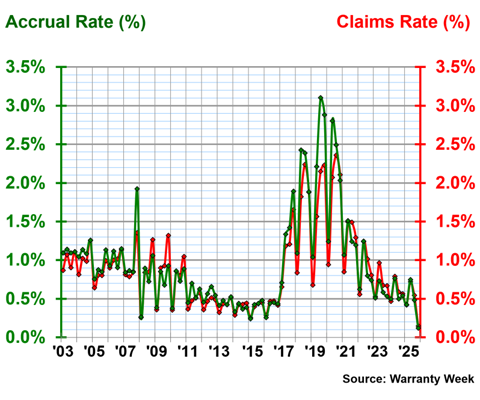
Figure 4 shows the average warranty expense rates for the U.S. security manufacturers, from 2003 to 2025.
Figure 4
U.S. Security Equipment Manufacturers
Average Warranty Claims & Accrual Rates
(as a % of product sales, 2003-2025)
Over 23 years, the U.S. security industry had an average warranty claims rate of 0.62%, with a standard deviation of 0.24%, and an average warranty accrual rate of 0.66%, with a standard deviation of 0.30%.
In 2025, the security industry had an average warranty claims rate of 0.64%, and an average warranty accrual rate of 0.61%.
Figure 5 shows the average quarterly warranty expense rates for the U.S. sports manufacturers, from 2003 to 2025.
Figure 5
U.S. Sports Equipment Manufacturers
Average Warranty Claims & Accrual Rates
(as a % of product sales, 2003-2025)
Over 23 years, the sports industry had an average warranty claims rate of 0.87%, with a standard deviation of 0.51%, and an average warranty accrual rate of 0.94%, with a standard deviation of 0.62%.
In 2025, the sports industry had an average warranty claims rate of 0.46%, and an average warranty accrual rate of 0.44%. On a quarterly basis, the rates fluctuated widely, from both expense rates at about 0.75% in the second quarter, and falling to about 0.15% in the fourth quarter.
Warranty Reserve Balances
Figure 6 shows the total warranty reserves held by the manufacturers in the U.S.-based material handling, sports, and security industries, from 2003 to 2025.
Figure 6
Other Product Warranties by Industry
Reserves Held by U.S.-based Manufacturers
(in US$ millions, 2003-2025)
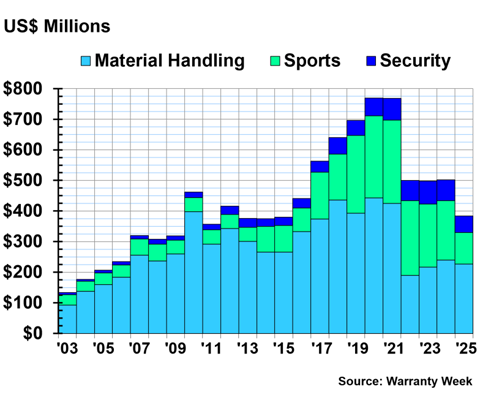
At the end of 2025, the U.S.-based material handling industry held $226 million in warranty reserves, a -6% decrease from the end of 2024.
Ingersoll Rand held $54 million in warranty reserves at the end of 2025, a -20% decrease from the end of 2024. Xylem held $53 million in warranty reserves, a -7% decrease.
Flowserve held $37 million in warranty reserves at the end of 2025, a -17% increase from the end of 2024. Mueller Water Products held $26 million in reserves at the end of 2025, an 8% increase. Idex held $14 million in reserves, a 6% increase. Lindsay held $14 million in reserves, a 1% increase.
At the end of 2025, the U.S.-based security industry held $54 million in warranty reserves, a -21% decrease from the end of 2024.
Allegion held $26 million in warranty reserves at the end of 2025, a 15% increase from the end of 2024. MSA Safety held $12 million in reserves at the end of 2025, a -14% decrease. Axon held $11 million in reserves, a 31% increase.
The U.S.-based sports manufacturers held $104 million in warranty reserves at the end of 2025, a -46% decrease from the end of 2024.
PMI did not report its warranty reserve balance at the end of 2025.
Signet Jewelers held $34 million in warranty reserves at the end of 2025, a -17% decrease. Peloton held $22 million in reserves, a 5% increase. Johnson Outdoors held $13 million in reserves, a 3% increase.
Check out the rest of our series of 23-year charts:
23rd Annual Product Warranty Report
Vehicle Sector
- U.S. Passenger Vehicle Warranty Expenses
- U.S. Truck & Bus Warranty Expenses
- U.S. Auto Parts & Powertrain Warranty Expenses
- U.S. Aerospace Warranty Expenses
Building Trades Sector
- U.S. New Home & Building Materials Warranty Expenses
- U.S. HVAC & Appliance Warranty Expenses Expenses
- U.S. Power Generation Equipment Warranty Expenses
Electronics Sector
- U.S. Electronics Warranty Report
- U.S. Semiconductor Warranty Expenses
- U.S. Telecom Equipment Warranty Expenses
- U.S. Medical & Scientific Equipment Warranties