

Top Japanese Automaker Warranty Expenses:
Toyota's warranty costs increased by about 40% from fiscal 2025 to 2024, across all six of our warranty metrics. It's likely this increase is related to the recall of 1.5 million vehicles in late 2025.
This week, we're taking a look at the warranty expenses of the top four largest Japanese automakers, Honda, Toyota, Nissan, and Subaru. Japanese automakers use a fiscal year that spans from April 1 to March 31.
Some Japanese automakers consider April 1, 2025 to March 31, 2026 the 2026 fiscal year, while others consider it fiscal 2025. Consistent with our methodology, we will refer to this timespan as fiscal 2025, based on which calendar year in which the majority of the fiscal year occurred.
For a frame of reference, based on the IRS exchange rate table: in 2024 and 2025, $1 USD was worth roughly ¥150; in 2023, $1 was worth about ¥140; in 2022, $1 was worth about ¥130; and, in 2021, $1 was worth about ¥110.
Especially in the post-pandemic era of 2022 and 2023, the yen fluctuated significantly. While we use the IRS exchange rates, other exchange rates are equally valid. In this week's newsletter, we are presenting the top Japanese automakers' warranty expenses in Japanese yen. In our upcoming annual worldwide automaker warranty report, we will convert these data to U.S. dollars.
Japanese Automakers
Amongst all Japanese automakers, Toyota, Honda, and Nissan account for about three-quarters of total product revenue, and three-quarters of all limited warranty expenses.
Toyota owns the Lexus, Hino, Daihatsu, and Century brands, and owns 20% of Subaru, 5% of Mazda, Suzuki, and Isuzu, and 4% of Yamaha. Toyota has joint ventures with FAW and GAC in China, and shares a factory in Alabama 50/50 with Mazda.
Honda owns the Acura brand, and has several joint ventures with Chinese automakers, including Dongfeng and GAC. Honda also has a jet engine joint venture with GE Aerospace, called GE Honda Aero Engines.
Nissan also owns the Infiniti brand. Since 1999, Nissan has been in an alliance with Renault, in which each currently owns 15% of the other. Mitsubishi joined the alliance in 2016, and Nissan currently owns 25% of Mitsubishi.
Honda and Nissan were in talks for a possible merger in 2024, but announced in February 2025 that negotiations fell through.
Methodology
Mitsubishi also reports its warranty expenses, and Suzuki, Mazda, and Isuzu report some, but not all, warranty metrics. Unfortunately, as of the publish date of this newsletter, Subaru has yet to publish its annual report for its fiscal year 2026 (April 1, 2025 - March 31, 2026). However, we included Subaru's data from fiscal 2021 to 2024 in Figures 1, 3, 5, and 6.
To create this newsletter, we perused the annual reports of Honda, Toyota, Nissan, and Subaru, and gathered three key warranty metrics: the amount of claims paid, the amount of accruals made, and the end-balance of the warranty reserve fund.
Nissan only reports warranty accruals and reserve balances, so we used these two figures to estimate the total amount of warranty claims paid per year.
In addition, we gathered data on each manufacturer's total vehicle sales revenue and the total number of vehicles sold. We used these to calculate three warranty expense rates: claims as a percentage of vehicle sales (the claims rate), accruals as a percentage of vehicle sales (the accrual rate), and accruals made per vehicle sold (in ¥ Japanese yen).
Warranty Claims Totals
Figure 1 shows the total warranty claims paid by the top Japanese automakers, from 2021 to 2025. Keep in mind that the data for Nissan are estimates.
Figure 1
Japanese Auto Manufacturers
Claims Paid per Year
(in billions of ¥ yen, fiscal 2021-2025)
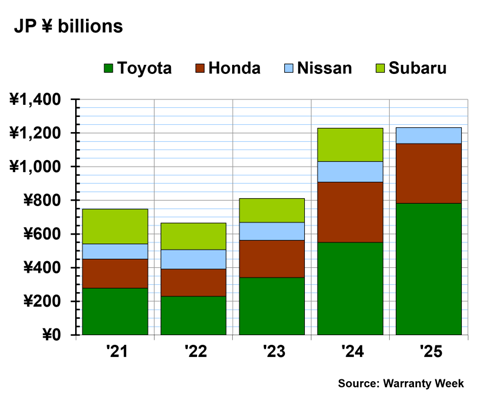
Toyota paid ¥782 million in warranty claims in 2025, a 42% increase from 2024. From 2023 to 2024, Toyota saw its claims costs increase by 60%. Fiscal 2025 was the third year in a row in which Toyota's claims costs increased.
In September 2025, Toyota recalled about 1.5 million vehicles worldwide, due to an issue with digital dashboards suddenly going blank. This number included about 600,000 vehicles recalled in the U.S., about 650,000 vehicles recalled in Japan, and about 230,000 recalled in China. The remedy was a software update for ICE vehicles, while the fix for plug-in hybrids required the replacement of the entire instrument assembly.
Honda paid ¥355 million in warranty claims in 2025, a -1% decrease from 2024. Honda's claims costs rose by 60% from 2023 to 2024, and remained at that elevated level in 2025. That 60% rise was a result of the December 2023 recall of 4.5 million vehicles worldwide due to a fuel pump defect. While Honda had a few smaller recalls in 2025, we'd assume that the automaker was still paying claims related to that largescale recall during fiscal 2025.
We estimate that Nissan paid about ¥94 million in warranty claims in 2025, a -23% decrease from 2024.
Warranty Claims Rates
Figure 2 shows the annual warranty claims rates of the top three Japanese automakers, from 2021 to 2025.
The claims rates for Nissan are calculated using our estimates for total warranty claims paid, and real data for total vehicle sales in the denominator.
Figure 2
Japanese Auto Manufacturers
Warranty Claims Rates
(as a percentage of sales, fiscal 2021-2025)
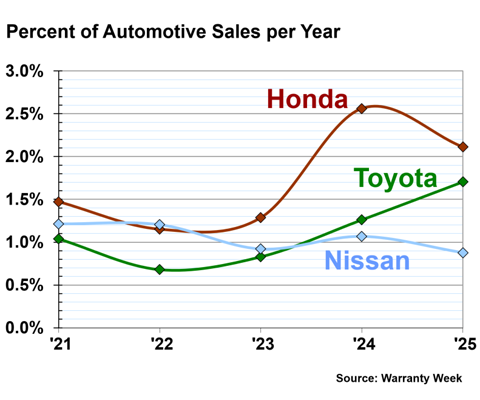
From fiscal 2024 to 2025, Toyota's warranty claims rate increased, while Honda's decreased.
In fiscal 2025, Toyota had a warranty claims rate of 1.71%, up about one-third from fiscal 2024.
Honda had a warranty claims rate of 2.11% in fiscal 2025, down about one-fifth from 2024. We estimate Nissan had a claims rate of 0.88% in fiscal 2025.
Warranty Accrual Totals
Figure 3 shows the total warranty accruals made by the top Japanese automakers, from 2021 to 2025.
Figure 3
Japanese Auto Manufacturers
Accruals Made per Year
(in billions of ¥ yen, fiscal 2021-2025)
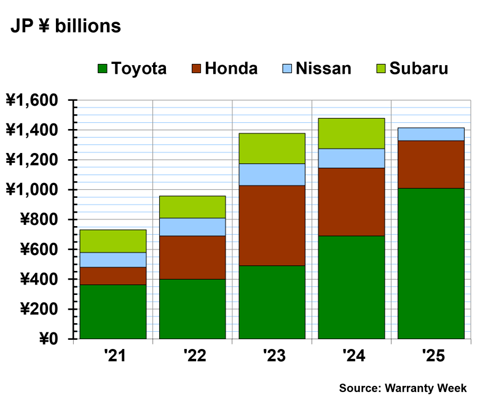
Toyota set aside ¥1.01 billion in warranty accruals in 2025, a 46% increase from 2024. Toyota has increased its warranty accruals every year for the past five fiscal years.
Honda set aside ¥320 million in warranty accruals in 2025, a -30% decrease from 2024. Honda set aside the majority of the funds related to the recall of 4.5 million vehicles during fiscal 2023.
Nissan set aside ¥86 million in warranty accruals in 2025, a -34% decrease from 2024.
Warranty Accrual Rates
Figure 4 shows the annual warranty accrual rates for the top three Japanese automakers, from 2021 to 2025.
Figure 4
Japanese Auto Manufacturers
Warranty Accrual Rates
(as a percentage of sales, fiscal 2021-2025)
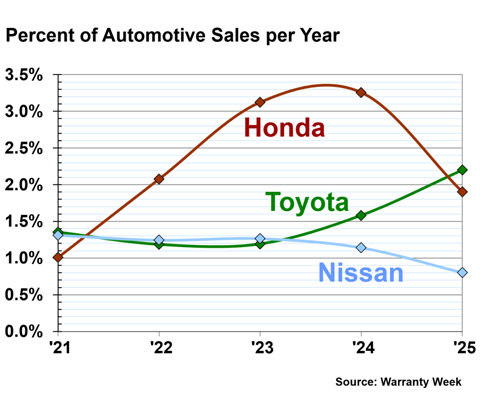
Toyota's warranty accrual rate increased in fiscal 2025, while Honda's and Nissan's decreased.
In fiscal 2025, Toyota had a warranty accrual rate of 2.20%, up by about two-fifths from fiscal 2024. Toyota's total accruals increased by a similar degree, showing that its elevated 2025 warranty expenses were not a result of more vehicles sold, but rather of higher warranty costs per vehicle.
Honda had a warranty accrual rate of 1.90% in fiscal 2025, a decrease by about two-fifths from fiscal 2024. Nissan had an accrual rate of 0.80% in fiscal 2025, a decrease by about one-third from fiscal 2024.
Accruals per Vehicle Sold
Global automakers always publish the total number of vehicles they sell worldwide each year, so we use these to calculate one additional warranty expense rate, the average amount of warranty accruals made per vehicle sold.
Of course, the top Japanese automakers don't only make passenger vehicles. Toyota makes boats and buses, Honda makes motorcycles, jet engines, planes, and generators, and Nissan makes truck and boat engines.
The Japanese automakers do not segment their unit sales figures, but we can safely assume that a large majority of each manufacturer's revenue is from passenger car sales. For example, 80% of Honda's product sales revenue comes from cars. Even if the warranty expenses of motorcycles or generators are different, it won't change the averages tremendously.
Figure 5 shows the average warranty accruals per vehicle sold for the top Japanese automakers, from 2021 to 2025.
Figure 5
Japanese Auto Manufacturers
Accruals Made per Vehicle Sold
(in ¥ yen, fiscal 2021-2025)
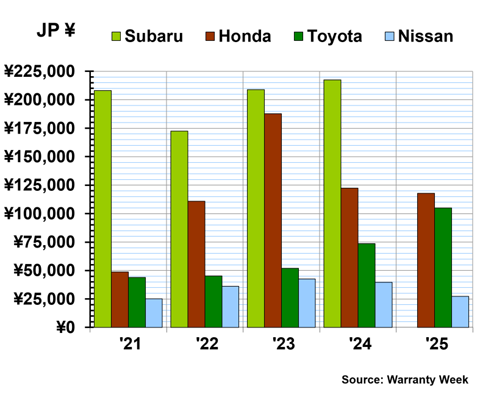
In fiscal 2025, Toyota set aside an average of ¥105,121 per vehicle sold, up 43% from fiscal 2024.
Honda set aside an average of ¥117,895 per vehicle sold during fiscal 2025, a decrease of -26% from fiscal 2024. Nissan set aside an average of ¥27,398 per vehicle sold during fiscal 2025, a -31% decrease from fiscal 2024.
Warranty Reserve Balances
Figure 6 shows the balance of each top Japanese automaker's warranty reserve fund, at the end of each fiscal year (March 31), from 2021 to 2025.
Figure 6
Japanese Auto Manufacturers
Reserves Held at Year's End
(in billions of ¥ yen, fiscal 2021-2025)
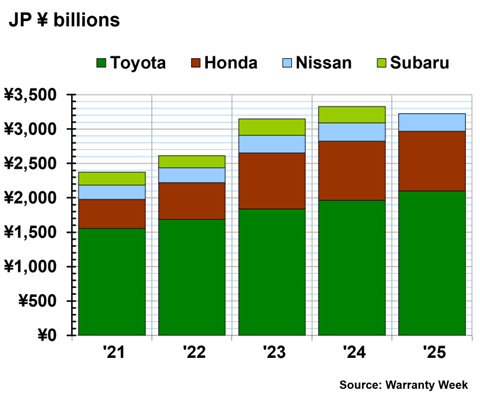
At the end of fiscal 2025, Toyota held ¥2.10 billion in warranty reserves, a 7% increase from the end of fiscal 2024.
Since the reserve balance only increased a bit, but total claims and accruals increased by about 40% each, we see that Toyota increased its accruals in order to meet the higher volume and cost of warranty claims, rather than to grow the size of its warranty reserves in anticipation of future costs. In other words, Toyota is allocating a larger portion of revenue to warranty, just to keep up with the increased volume of claims.
Honda held ¥867 million in warranty reserves at the end of fiscal 2025, a 1% increase from the end of fiscal 2024. Nissan held ¥258 million in warranty reserves at the end of fiscal 2025, a -3% decrease from the end of fiscal 2024.
Check out some more newsletters on the 2025 warranty expenses of worldwide automakers: