

Mid-Year U.S. Auto Warranty Expenses:
In the second quarter of 2026, the U.S.-based automakers set a new record high for warranty claims paid and reserves held. Year-over-year, Ford, GM, Tesla, and Rivian saw their total claims costs rise, but decreased their warranty accruals.
Two of the Big Three American automakers are still based in the United States, General Motors and Ford. In recent years, we've seen a few U.S.-based electric vehicle manufacturers emerge, including Tesla and Rivian.
Warranty costs have been rising across the global auto industry since the pandemic. Higher warranty costs have hit Ford and GM hard in the past few years. Ford was in the news in July 2024, when its stock plummeted after its CEO and CFO blamed high warranty costs for a decrease in profit.
Since then, we haven't seen warranty costs decrease to pre-pandemic levels for any of the U.S.-based automakers. In fact, we posit that elevated warranty costs are the new normal.
Parts and labor costs have increased. In addition, in-vehicle electronics are far more numerous and complex. Electronic panels, sensors, and components are expensive to replace, especially as the AI boom drives up chip prices. Furthermore, most dealer mechanics are not trained electricians, so panels that may be repairable are typically replaced, driving up the average repair cost.
On the other hand, more electronic components enables automakers to issue over-the-air (OTA) updates, initiate preventative maintenance, and detect recalls far sooner. Recalls solved by OTA updates are also far cheaper and easier to handle. While these benefits offer lower costs in the long term, we have yet to see warranty costs decrease in the immediate term from the largest U.S.-based automakers.
Recalls & Warranty Woes
The largest U.S.-based automakers have each experienced significant recalls in the past few years. Although Ford's recalls have garnered the most media attention, we have also seen recalls from GM, Tesla, and Rivian.
In September 2025, Ford announced the recall of 1.9 million vehicles globally, from the model years 2015-2019, due to defective rearview cameras. This recall included 1.45 vehicles in the United States. When the recall was issued, there were 18 related accidents, and 44,123 associated warranty claims. Ford linked this defect to "an unauthorized change by a sub-supplier to the printed circuit board header tooling."
In 2025, NHTSA recorded 153 recalls from Ford, by far the most of any automaker. In 2026 so far, Ford has reported 67 recalls, again leading the pack. Not every recall is large, but they are far more numerous from this manufacturer, compared to any other automaker doing business in the United States.
In February 2026, Ford recalled 4.4 million trucks and SUVs. Luckily for the automaker, this was a software defect, solved by an OTA software update issued remotely. Ford was able to detect this defect after just 405 warranty claims.
In March 2026, Ford issued two recalls, affecting a total of 1.74 million vehicles, due to software issues impacting rearview camera displays. This was another software recall fixed by an OTA update.
Similarly, in June 2026, Ford recalled 750,000 vehicles over a transmission defect, which was partially fixed by an OTA update. However, the remedy for this recall also involved an inspection of the transmission, and the potential replacement of components.
Ford has experienced the highest total number of recalls for the past few years, and its warranty costs have garnered a good deal of attention. However, many of those recalls are of a small number of vehicles, with defects detected early, and recalls issued quickly.
GM, Tesla, and Rivian have had their fair share of large recalls in recent years as well.
In late 2024, GM recalled over 400,000 vehicles for a transmission defect that could cause wheels to lock up unexpectedly. GM expanded the recall to another 90,000 vehicles in March 2025.
In April 2025, GM recalled nearly 600,000 vehicles due to a faulty connecting rod, which could cause engine damage or failure.
Compared to those of Ford, GM's recalls affected far fewer vehicles. However, replacing half a million engines and transmissions is a far more costly undertaking, compared to issuing an OTA software update to several million vehicles. The total number of recalls doesn't tell the whole story.
Ford's warranty claims costs were up in 2026, but so were those of GM, Tesla, and Rivian. Before we take a look at the total warranty expenses associated with these recalls, we'll also note a few recent large recalls from the U.S.-based EV-only manufacturers.
In August 2026, Tesla was one of many EV manufacturers mandated to phase out its concealed door handle design in China, due to concerns the doors are difficult to open in an emergency. Tesla alone recalled 3 million vehicles in the country, and is offering remedies including door handle warning labels, and an OTA update that automatically opens vehicle windows after a collision. Starting in 2027, China is prohibiting the sale of vehicles with concealed door handles, so Tesla is required to change its design.
In February 2025, Rivian recalled 17,000 vehicles from the 2025 model year for a headlight issue. Rivian delivered 42,000 vehicles globally in 2025.
In December 2025, Rivian recalled about 35,000 delivery vans due to a seatbelt defect. In January 2026, Rivian recalled about 20,000 vehicles due to an incorrectly assembled rear toe link. There was one crash associated with the defect at the time of this recall.
Methodology
To create this newsletter, we perused the quarterly reports of Ford Motor Co., General Motors Co., Tesla Inc., and Rivian Automotive Inc. We gathered three key warranty metrics: the amount of claims paid, the amount of accruals made, and the end-balance of the warranty reserve fund.
We also gathered data from Lucid Motors, but its warranty expenses were too small to show up in our charts.
In addition, we gathered data on each manufacturer's total vehicle sales revenue, and used these to calculate our two warranty expense rates: claims as a percentage of sales (the claims rate), and accruals as a percentage of sales (the accrual rate).
Warranty Claims Totals
Figure 1 shows the total warranty claims paid by the largest four U.S.-based automakers, from 2021 to the second quarter of 2026.
Figure 1
U.S.-based Auto Manufacturers
Claims Paid per Quarter
(in millions of U.S. dollars, 2021-2026)
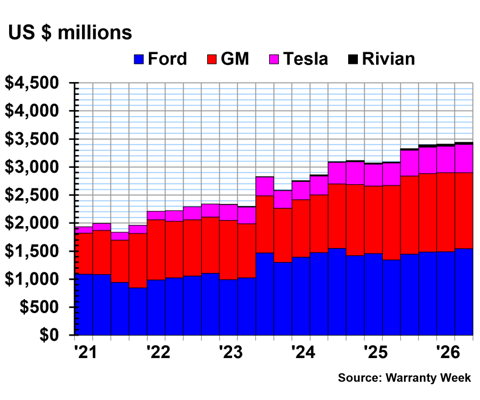
In the first quarter of 2026, Ford paid $1.49 billion in warranty claims, a year-over-year increase of 2%, compared to the first quarter of 2025. In the second quarter of 2026, Ford paid $1.54 billion in claims, a 15% increase from the second quarter of 2026.
GM paid $1.42 billion in warranty claims in the first quarter of 2026, an 18% increase from the first quarter of 2025. In the second quarter of 2026, GM paid $1.36 billion in claims, a 2% year-over-year increase.
Tesla paid $468 million in warranty claims in the first quarter of 2026, a 19% increase from the first quarter of 2025. In the second quarter of 2026, Tesla paid $504 million in claims, a 27% year-over-year increase.
In the first quarter of 2026, Rivian paid $37 million in warranty claims, a 76% increase from the first quarter of 2025. In the second quarter of 2026, Rivian paid $36 million in claims, double its claims costs in the second quarter of 2025.
Warranty Claims Rates
Figure 2 shows the quarterly warranty claims rates of these four U.S.-based automakers, from 2021 to the second quarter of 2026.
Figure 2
U.S.-based Auto Manufacturers
Warranty Claims Rates
(as a % of product sales, 2021-2026)
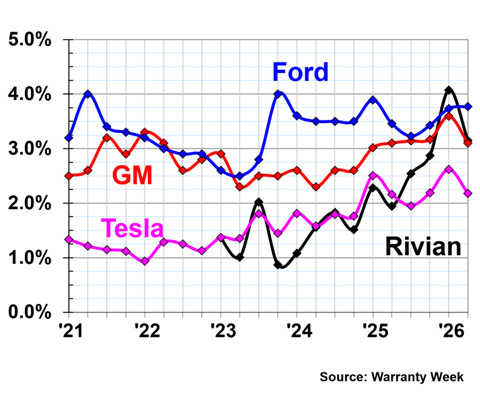
In the second quarter of 2026, Ford had a warranty claims rate of 3.77%. GM had a claims rate of 3.10%. Tesla had a claims rate of 2.18%.
Rivian had a claims rate of 3.15% in the second quarter of 2026, up by two-thirds from the second quarter of 2025.
Warranty Accrual Totals
Figure 3 shows the total warranty accruals made by the four largest U.S.-based automakers, from 2021 to the second quarter of 2026.
Figure 3
U.S.-based Auto Manufacturers
Accruals Made per Quarter
(in millions of U.S. dollars, 2021-2026)
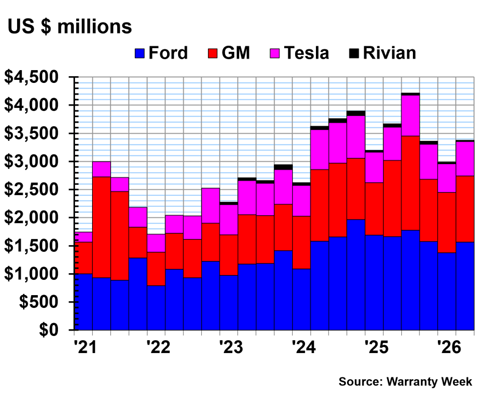
In the first quarter of 2026, Ford set aside $1.37 billion in warranty accruals, a -19% decrease from the first quarter of 2025. In the second quarter of 2026, Ford set aside $1.57 billion in accruals, a -6% decrease from the second quarter of 2025.
GM set aside $1.08 billion in warranty accruals in the first quarter of 2026, a 15% increase from the first quarter of 2025. GM set aside $1.18 billion in accruals in the second quarter of 2026, a -13% year-over-year decrease.
Tesla set aside $508 million in warranty accruals in the first quarter of 2026, a -6% decrease from the first quarter of 2025. Tesla set aside $615 million in accruals in the second quarter of 2026, a 4% year-over-year increase.
Rivian set aside $28 million in warranty accruals in the first quarter of 2026, a -18% decrease from the first quarter of 2025. In the second quarter of 2026, Rivian set aside $21 million in accruals, a -63% year-over-year decrease.
Note that all four U.S.-based automakers decreased their year-over-year warranty accruals, although their warranty claims costs increased over the same period.
Warranty Accrual Rates
Figure 4 shows the quarterly warranty accrual rates for Ford, GM, and Tesla, from 2021 to the second quarter of 2026. We did not chart Rivian's accrual rates, as many of the values far exceeded the scale of Figure 4.
Figure 4
U.S.-based Auto Manufacturers
Warranty Accrual Rates
(as a % of product sales, 2021-2026)
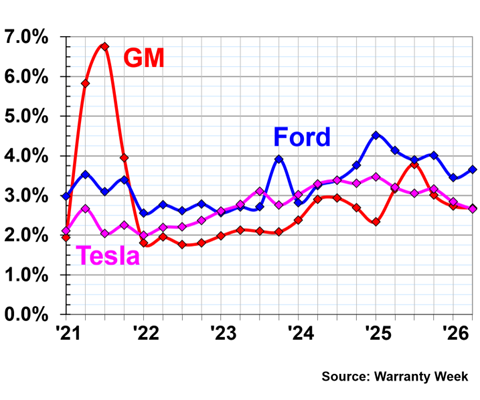
In the second quarter of 2026, Ford had a warranty accrual rate of 2.68% GM had a warranty accrual rate of 3.66%. Tesla had an accrual rate of 2.66%.
Rivian's warranty accrual rate fluctuates very widely. In the first quarter of 2026, Rivian had an accrual rate of 3.08%, and in the second quarter, an accrual rate of 1.84%. In 2025, Rivian's accrual rates ranged from 3% to 6%, and in 2024, from 4% to 9%.
Warranty Reserve Balances
Figure 5 shows the warranty reserves held by the four U.S.-based automakers at the end of each quarter, from 2021 to the second quarter of 2026.
Figure 5
U.S.-based Auto Manufacturers
Reserves Held per Quarter
(in millions of U.S. dollars, 2021-2026)
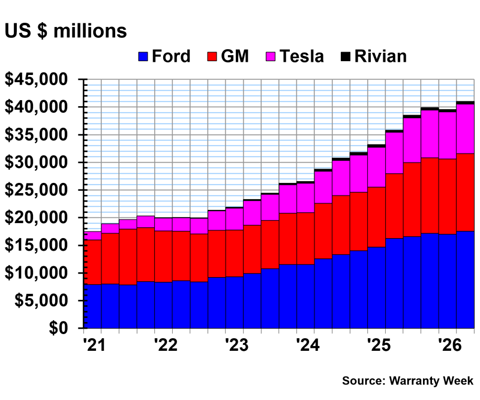
At the end of the second quarter of 2026, Ford held $17.57 billion in warranty reserves, an 8% year-over-year increase.
GM held $14.02 billion in warranty reserves at the end of the second quarter of 2026, a 20% year-over-year increase.
Tesla held $8.96 billion in warranty reserves at the end of the second quarter of 2026, a 19% year-over-year increase. Rivian held $452 million in warranty reserves at the end of the second quarter of 2026, a 16% year-over-year increase.
Check out some more newsletters on the 2025 warranty expenses of worldwide automakers:
- U.S. Auto Warranty Expenses
- European Automaker Warranty Expenses
- Top Japanese Automaker Warranty Expenses