

Top Chinese Automaker Warranty Expenses:
Ten Chinese automakers publish their annual warranty expenses, including both state- and privately-owned OEMs. Many Chinese OEMs are setting aside extra funds in warranty accruals, perhaps expecting warranty expenses to increase as they expand their international sales.
As Chinese automakers move into the European and American markets, many have started publishing their annual warranty expenses in their integrated reports. Warranty reporting is still uncommon in China, but a growing number of Chinese automakers are beginning to conform to the Western norm by disclosing their product warranty costs.
We are still missing warranty data from a few of the largest Chinese automakers, including Geely Group, Chery, FAW Group, JAC Motors, Xiaomi, and Leapmotor. Rather than rely on estimates for these automakers, we will refrain from using our data for any market sizing of Chinese auto warranty.
However, we do have hard data available from 10 Chinese automakers: BYD, SAIC, Changan, BAIC, Dongfeng, Great Wall, GAC Group, Li Auto, Nio, and Xpeng. BYD, along with the latter three automakers, are makers of electric vehicles only, while the other six automakers produce both EVs and internal combustion engine (ICE) vehicles.
Chinese Vehicles
Chinese automakers continued to expand their global exports in 2025, and have especially taken off in 2026. Just this week, it was announced that Chinese vehicles outsold Japanese vehicles across Europe in the third quarter of 2026. Chinese vehicle registrations in Europe doubled from September 2025 to September 2026, led by stronger demand for low-cost EVs as global gas prices surged.
In October 2024, the European Union imposed tariffs on Chinese-made battery EVs (BEVs). The tariff does not affect plug-in hybrid EVs (PHEVs), which have surged in popularity since the tariff was imposed.
More recently, the European Union has debated imposing "Made in Europe" rules for vehicles. Some Chinese automakers are already preparing for the pending decision, with plans to open new European factories and establish European supply chains.
Beyond the growing European market for Chinese cars, these automakers are moving into the Latin American market, especially Brazil and Mexico, and are quickly capturing a massive share of the Russian vehicle market, filling the void left by the exit of Western automakers. Chinese vehicles, both ICE and EV, are also growing in popularity in the Middle East and Africa.
Of course, China is the world's second most populated country, and largest auto market. However, we have found that Chinese automakers engaged just in domestic sales rarely publish their warranty expenses. Furthermore, Chinese automakers generally see their warranty costs increase when they move into international markets.
Methodology
We searched for every major Chinese automaker's annual report, and identified 10 OEMs that publish product warranty data: BAIC, BYD, Changan, Dongfeng, GAC, Great Wall, Li Auto, Nio, SAIC, and Xpeng.
For each automaker, we gathered three key warranty metrics: the amount of claims paid, the amount of accruals made, and the end-balance of the warranty reserve fund.
We also gathered data on each OEM's vehicle sales revenue, and total unit sales, and used these to calculate three warranty expense ratios: claims as a percentage of sales (the claims rate), accruals as a percentage of sales (the accrual rate), and accruals per vehicle sold (in USD).
Chinese automakers report in Chinese yuan. For this newsletter, we converted these data to U.S. dollars using the IRS Yearly average currency exchange rates table.
We formed estimates to fill in gaps in our data when necessary. SAIC and Great Wall report their warranty reserve end-balance and accruals made, but not their claims paid, so we do some subtraction to calculate the remaining metric.
In addition, BYD and Dongfeng have publish their warranty expenses in past years, but did not report them in 2025. We calculated estimates for these two automakers for 2025, and hope they will return to reporting next year.
Chinese Automakers
Changan and Dongfeng are both central state-owned manufacturers, along with FAW, which does not report its warranty expenses. SAIC (Shanghai), GAC (Guangzhou), and BAIC (Beijing) are local state-owned manufacturers, owned by Chinese city municipal governments, along with JAC (Anhui), which does not report.
BYD, Great Wall Motor, Li Auto, Xpeng, and Nio are all privately owned automakers (as are non-reporters Geely Auto, Leapmotor, and Xiaomi).
BYD, short for "Build Your Dreams," is the largest global EV-only auto brand, surpassing Tesla in the Chinese and European markets in recent years. BYD's product line is about half PHEVs, and half BEVs.
BYD opened factories in Thailand and Uzbekistan in 2024, and started production in a former Ford factory in Brazil in July 2025. BYD also announced plans to begin production at its new facility in Szeged, Hungary by the end of 2026.
SAIC acquired the MG Motor brand in 2007, and also sells vehicles under the Maxus, LDV, IM Motors, Rising Auto, Roewe, Wuling, and Baojun brands. SAIC is one of the largest global vehicle exporters from China.
Changan owns the Deepal and Avatr brands. BAIC owns the Arcfox, Beijing, and Foton brands. Dongfeng owns the Voyah, Aeolus, Forthing, Dongfeng Nammi, and M-Hero brands. GAC owns the Aion, Trumpchi, and Hyptec brands. Great Wall owns the Haval, Wey, Tank, and Ora brands, and has a joint venture with BMW called Spotlight Automotive, which produces Mini brand EVs.
BYD, Xpeng, Li Auto, and Nio produce electric vehicles. While BYD pivoted from ICE to EVs in the 2010s, Xpeng, Nio, and Li Auto are three BEV startups.
Li Auto specializes in extended range EVs, or EREVs, which use a built-in petrol engine to charge the battery, extending the vehicle range between charges. EREVs are different from PHEVs; although both use an electric motor and secondary gas engine, the function of that ICE component is different.
Nio specializes in battery-swap technology. Rather than relying on a charging network, Nio service stations are able to swap in a charged battery. Nio's 3,800 battery swap stations across China change EV batteries in about five minutes. Nio has also opened about 60 battery swap stations across Europe, mainly in Norway, Germany, the Netherlands, and Sweden.
Warranty Claims Totals
Figure 1 shows the total amount of warranty claims paid by the 10 Chinese automakers that report their warranty expenses, from 2021 to 2025.
Figure 1
Top Chinese Auto Manufacturers
Claims Paid per Year
(in millions of U.S. dollars, 2021-2025)
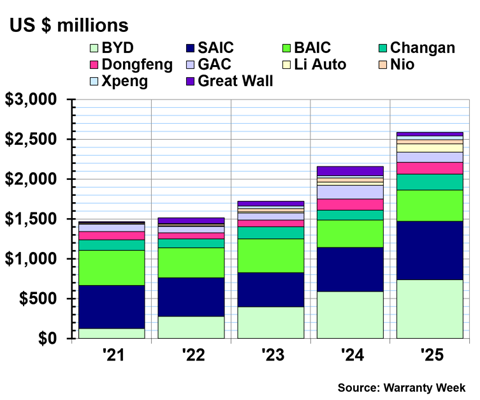
BAIC paid $390 million in warranty claims in 2025, a 13% increase from 2024. Changan paid $203 million in claims in 2025, a 62% increase. GAC paid $127 million in claims, a -27% decrease.
Li Auto paid $104 million in warranty claims in 2025, more than double 2024's total. Nio paid $52 million in claims, a 5% increase. Xpeng paid $50 million in warranty claims in 2025, a 71% increase from 2024.
We estimate that BYD paid $737 million in warranty claims in 2025, an increase of 25%. We estimate that SAIC paid $734 million in claims, an increase of 33%. We estimate that Dongfeng paid $147 million in claims, a 7% increase.
Warranty Claims Rates
Figure 2 shows the annual warranty claims rates for the four Chinese ICE vehicle OEMs, from 2021 to 2025.
Figure 2
Top Chinese ICE Vehicle Manufacturers
Warranty Claims Rates
(as a percentage of sales, 2021-2025)
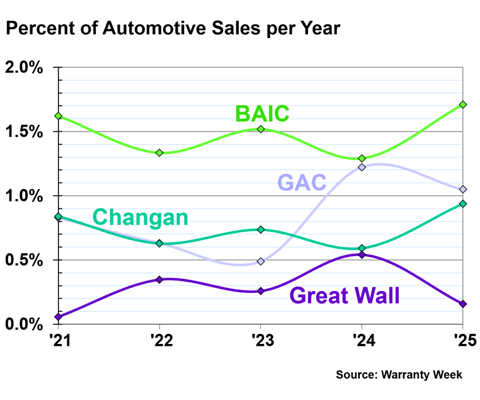
In 2025, the average warranty claims rate for Chinese automakers was 0.8%.
BAIC had the highest warranty claims rate of the group. In 2025, BAIC had a warranty claims rate of 1.71%, an increase of about one-third from 2024.
GAC had a claims rate of 1.05% in 2025, a decrease of about one-sixth from 2024. Changan had a claims rate of 0.94% in 2025, an increase of about one-half from 2024. Great Wall had a claims rate of 0.16% in 2025, a decrease of about three-quarters from 2024.
Figure 3 shows the annual warranty claims rates for the three Chinese EV manufacturers, from 2021 to 2025. Figures 2 and 3 are on the same y-axis scale for ease of comparison.
Figure 3
Top Chinese EV Manufacturers
Warranty Claims Rates
(as a percentage of sales, 2021-2025)
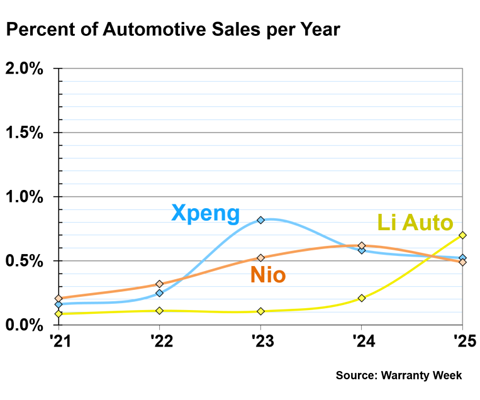
Li Auto had a warranty claims rate of 0.70% in 2025, more than triple its claims rate in 2024. Xpeng had a claims rate of 0.52% in 2025, a slight decrease from 2024. Nio had a claims rate of 0.49% in 2025, a decrease of about one-quarter from 2024.
Total Warranty Accruals
Figure 4 shows the total warranty accruals made by the Chinese automakers, from 2021 to 2025.
Figure 4
Top Chinese Auto Manufacturers
Accruals Made per Year
(in millions of U.S. dollars, 2021-2025)
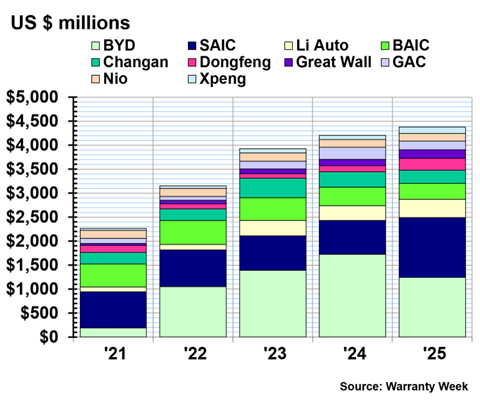
We estimate that BYD set aside $1.25 billion in warranty accruals in 2025, a -28% decrease from 2024. We estimate that SAIC set aside $1.24 billion in accruals, a 75% increase.
Li Auto set aside $380 million in warranty accruals in 2025, a 24% increase from 2024. BAIC set aside $336 million in warranty accruals, a -13% decrease. Changan set aside $273 million in accruals, a -16% decrease.
Great Wall set aside $181 million in warranty accruals in 2025, a 36% increase from 2024. GAC set aside $180 million in accruals, a -29% decrease. Nio set aside $156 million in accruals, a -4% decrease. Xpeng set aside $134 million in warranty accruals, a 61% increase.
Warranty Accrual Rates
Figure 5 shows the warranty accrual rates for four Chinese automakers, from 2021 to 2025. Figures 5 and 6 are on the same y-axis scale for ease of comparison.
Figure 5
Top Chinese ICE Vehicle Manufacturers
Warranty Accrual Rates
(as a percentage of sales, 2021-2025)
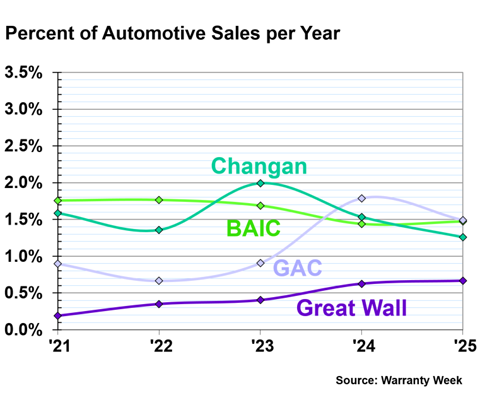
In 2025, the average warranty accrual rate for Chinese automakers was 1.4%.
GAC had a warranty accrual rate of 1.49% in 2025, a decrease of about one-sixth from 2024. BAIC had an accrual rate of 1.47% in 2025, a slight increase from 2024. Changan had an accrual rate of 1.26% in 2025, a decrease of about one-sixth from 2024. Great Wall had a warranty accrual rate of 0.67% in 2025, a slight increase from 2024.
Figure 6 shows the warranty accrual rates for the three Chinese EV manufacturers, from 2021 to 2025.
Figure 6
Top Chinese EV Manufacturers
Warranty Accrual Rates
(as a percentage of sales, 2021-2025)
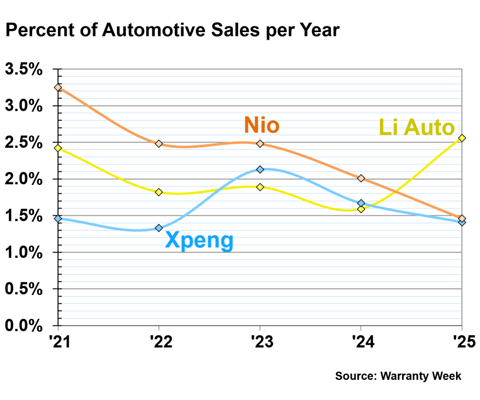
Li Auto had a warranty accrual rate of 2.56% in 2025, an increase of two-thirds from 2024. Nio had a warranty accrual rate of 1.46% in 2025, a decrease of about one-third from 2024. Xpeng had an accrual rate of 1.41% in 2025, a decrease of about one-sixth from 2024.
Accruals per Vehicle Sold
Global automakers report the number of vehicles they sell each year. Using these figures, along with the total warranty accruals shown in Figure 4, we calculate the average rate of warranty accruals per vehicle sold.
Figure 7 shows the average amount of warranty accruals set aside per vehicle sold by the 10 Chinese automakers, from 2021 to 2025.
Figure 7
Top Chinese Auto Manufacturers
Accruals Made per Vehicle Sold
(in U.S. dollars, 2024-2025)
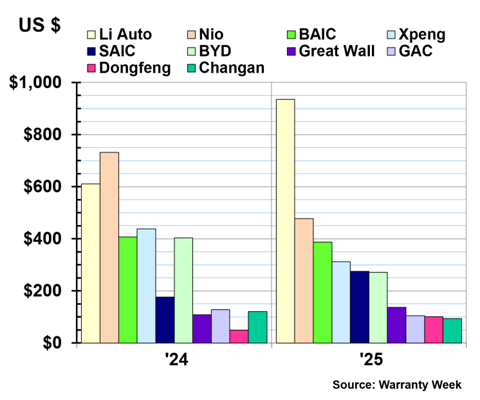
Among these Chinese automakers, Li Auto set aside the most funds in warranty accruals for each vehicle sold. In 2025, Li Auto set aside an average of $936 for each vehicle sold.
Fellow EV manufacturer Nio set aside an average of $477 in warranty accruals per vehicle sold in 2025, a -35% decrease from 2024. Xpeng set aside an average of $312 per vehicle sold in 2025, a -29% decrease.
BAIC set aside an average of $387 per vehicle sold in 2025, a -5% decrease from 2024. GAC set aside an average of $105 per vehicle sold in 2025, a -18% decrease. Changan set aside an average of $94 per vehicle sold in 2025, a -23% decrease.
We estimate that BYD and SAIC each set aside about $375 per vehicle sold. We estimate that Great Wall Motor set aside about $135 per vehicle sold in 2025. We estimate that Dongfeng set aside just $100 per vehicle sold in 2025.
Warranty Reserves Held
Figure 8 shows the amount of warranty reserves held by each Chinese automaker at the end of each fiscal year, from 2021 to 2025.
Figure 8
Top Chinese Auto Manufacturers
Reserves Held at Year's End
(in millions of U.S. dollars, 2021-2025)
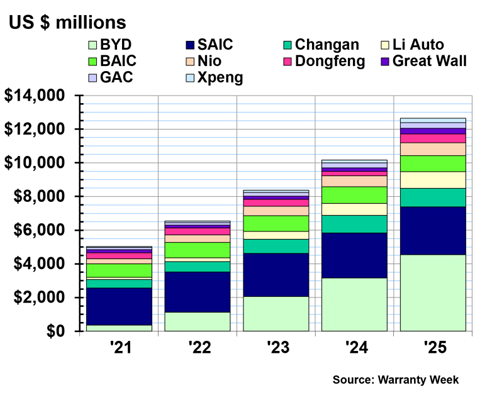
At the end of 2025, BYD held $4.54 billion in warranty reserves, a 44% increase from the end of 2024.
SAIC held $2.85 billion in warranty reserves at the end of 2025, a 6% increase from the end of 2024. Changan held $1.10 billion in warranty reserves, a 7% increase. Li Auto held $994 million in reserves, a 38% increase. BAIC held $945 million in warranty reserves, a -4% decrease.
Nio held $760 million in warranty reserves at the end of 2025, a 16% increase. Great Wall held $345 million in warranty reserves, a 67% increase. GAC held $339 million in reserves, a 19% increase. Xpeng held $250 million in reserves, a 50% increase.
More newsletters on 2025 worldwide automaker warranty expenses:
- U.S. Auto Warranty Expenses
- European Automaker Warranty Expenses
- Top Japanese Automaker Warranty Expenses
- Mid-Year U.S. Auto Warranty Expenses
- Top Korean & Indian Automaker Warranty Expenses
- Electric Vehicle Warranty Expenses