

Electric Vehicle Warranty Expenses:
Compared to manufacturers of ICE vehicles, pure-play EV manufacturers tend to have higher warranty accrual rates, reflecting a higher degree of caution in automakers' warranty accounting. We also see a dichotomy between the lower warranty expense rates of the Chinese EV automakers, and the higher expense rates of the U.S. EV automakers.
As the market share of electric vehicles grows globally, so do the warranty costs associated with EVs. In addition, a market for used EVs has emerged, as has a market for VSCs for EV batteries and powertrains.
In 2025, 9% of all new vehicles sold in the U.S. were EVs. U.S. electric vehicle sales soared in the third quarter of 2025, as consumers rushed to purchase new EVs before the $7,500 EV tax credit expired, then crashed in the final months of the year. In addition, without the tax incentive to manufacture EVs in the U.S., many automakers are ramping down EV production in their North American factories, some even transitioning back to producing ICE vehicles. Take a look at this Warranty Week newsletter for more information about EV production in the United States, and the end of the EV tax credit.
While the United States is seeing stagnant EV adoption rates, EVs are rapidly growing in popularity worldwide. In 2025, 25% of new cars sold globally were EVs.
In Norway, about 95% of new passenger cars sold in 2025 were EVs. Across Europe, 25% of new vehicles were EVs, on par with the global average.
In 2025, the Vietnamese EV market boomed, thanks to new domestic EV automaker VinFast. In 2025, BEVs accounted for 37% of new passenger cars sold in Vietnam, growing by two-thirds from 2024.
China: The Largest Global EV Market
China is one of the largest and fastest-growing global EV markets. In 2025, China accounted for about two-thirds of all global light-duty EV sales. 52% of all new cars sold in China in 2025 were EVs.
Many Chinese EV manufacturers are focusing on moving into other global markets, including Europe, Latin America (especially Brazil), the Middle East (e.g. UAE & Saudi Arabia), Southeast Asia (e.g. Thailand & Indonesia), and Australia.
BYD, the largest Chinese EV manufacturer, owns several factories across China, including its 50 square mile "mega-factory" currently under construction. In addition, BYD opened two factories in 2024, in Thailand and Uzbekistan, and took over a former Ford factory in Brazil in July 2025. BYD has also announced plans for new factories in Türkiye, Mexico, Indonesia, and Pakistan.
BYD is especially investing in growth in the European market, focusing on building factories, assembly plants, and supply chains in the EU, in order to comply with the tariffs the EU imposed on Chinese-made EVs in October 2024. BYD is currently opening its first European plant in Hungary, and has teased an upcoming announcement of a second manufacturing site. Take a look at this newsletter for more information about BYD's new factories and global expansion.
Other Chinese EV manufacturers selling in the EU, and possibly looking to open their own European factories, include Xpeng, which is another EV pure-play, along with Chery, Changan, Leapmotor, SAIC (under the MG Motor brand), Geely Auto (under the Zeekr brand), and GAC Group (under the GAC Aion brand).
EV "Pure-Plays"
Many of the largest global automakers manufacture EVs, and many have dedicated EV brands. Although some segment their revenue by vehicle type, automakers do not segment their warranty expenses in their annual reports. When an automaker produces both ICE vehicles and EVs, we cannot extrapolate the amount spent on warranty in each vehicle category.
There is a small number of global "pure-play" EV manufacturers. Most are based in either the United States or China, and many are startups that began production within the past decade. Conveniently for us, the largest global EV pure-plays report their warranty expenses — although we are missing data from Türkiye's new national EV manufacturer, Togg.
To create this newsletter, we perused the annual reports of the largest global pure-play EV automakers. Based in the United States, we gathered data from Tesla, Rivian, and Lucid Motors. Based in China, we gathered data from BYD, Xpeng, Nio, Li Auto, and Polestar. We also gathered data from VinFast, based in Vietnam.
While Polestar is headquartered in Sweden, it is a subsidiary of Geely Group, based in China. Although Geely Auto does not publish its warranty costs, Polestar publishes a separate annual report, which does include warranty expenses.
For each of these nine EV pure-plays, we perused their annual and quarterly reports, and gathered three key warranty metrics: the amount of claims paid, the amount of accruals made, and the end-balance of the warranty reserve fund. In addition, we gathered data on each automaker's vehicle sales revenue.
Using the claims and accrual totals, along with the vehicle sales totals, we calculated our two warranty expense rates: claims as a percentage of sales (the claims rate), and accruals as a percentage of sales (the accrual rate).
Tesla, Rivian, Lucid, and Polestar report in U.S. dollars; BYD, Xpeng, Nio, and Li Auto report in Chinese yuan; and VinFast reports in Vietnamese dong. Rather than convert currencies, this week, we're analyzing the warranty claims and accrual rates.
Warranty Expense Rates
Figure 1 shows the annual warranty claims and accrual rates of each global "pure-play" EV automaker, from 2024 to 2025. Those who attended the Mapconnected Service & Warranty Lifecycle Summit this week will recognize Figure 1 from our Editor-in-Chief Drew Arnum's presentation on the warranty expenses of global automakers.
Figure 1
"Pure-Play" Electric Vehicle Manufacturers:
Warranty Claims and Accrual Rates,
(as % of product revenue, 2024-2025)
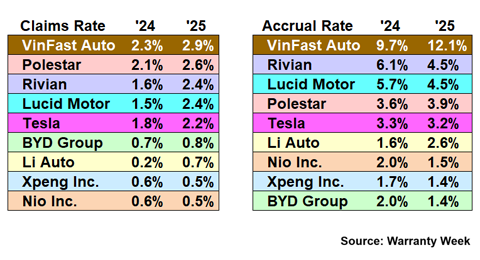
Overall, we've found that the U.S.-based EV manufacturers are very cautious with their approach to warranty accounting. They tend to set aside extra warranty funds, to create a "rainy day fund" to compensate for uncertainty about future warranty costs. Warranty accrual rates tend to be higher, while the claims rates stay closer to global averages — meaning, the big disaster hasn't come yet, but EV automakers continue to prepare, just in case.
On the other hand, we've found that Chinese automakers tend to have lower warranty expense rates. However, as the Chinese EV pure-plays move into international markets, especially Europe, their warranty claims and accrual rates have increased a bit.
The dichotomy between these two groups is visible in Figure 1, which shows the 2024 and 2025 warranty claims and accrual rates for the nine pure-play EV manufacturers.
VinFast, the newcomer to the industry, had the highest warranty claims and accrual rates among the EV pure-plays in 2025.
The following nine charts dive into the warranty expense rates of each pure-play EV automaker. Since most of these automakers are startups, we are able to chart their warranty expenses since they began producing vehicles.
Tesla
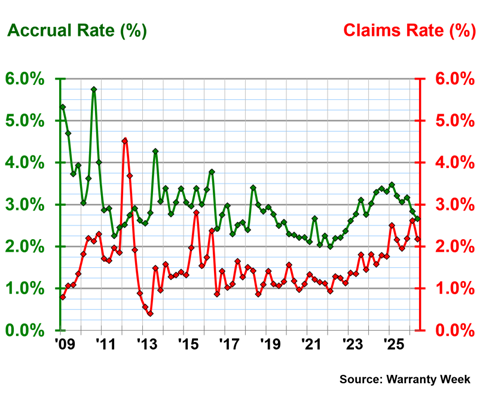
Figure 2 shows Tesla's warranty expense rates, from 2009 to the second quarter of 2026.
For bar graphs depicting Tesla's total warranty expenses, take a look at our September 8, 2026 newsletter "Mid-Year U.S. Auto Warranty Expenses."
Figure 2
Electric Vehicle Manufacturer Warranties:
Tesla, Claims and Accrual Rates,
(as % of product revenue, 2009-2026 Q2)
In August 2026, Tesla was one of many EV manufacturers mandated to phase out its concealed door handle design in China, due to concerns the doors are difficult to open in an emergency. Tesla alone recalled 3 million vehicles in the country, and is offering remedies including door handle warning labels, and an OTA update that automatically opens vehicle windows after a collision. Starting in 2027, China is prohibiting the sale of vehicles with concealed door handles, so Tesla is required to change its design.
Tesla's warranty claims rate has been on the rise steadily since 2022. At the same time, Tesla's accrual rate has dropped since the beginning of 2025.
In 2025, Tesla had an average warranty claims rate of 2.19%, an increase of one-quarter from 2024. In contrast, Tesla had an average warranty accrual rate of 3.16% in 2025, a slight decrease from 2024.
While Tesla still set aside more in accruals than it spent in claims in 2025, the gap between the two metrics became smaller, a trend we saw with BYD as well.
BYD
Figure 3 shows BYD's warranty expense rates, from 2006 to 2025. Note that BYD produced ICE vehicles until 2022. BYD produced its first EV in 2008, and gradually increased emphasis on that product line.
Figure 3
Electric Vehicle Manufacturer Warranties:
BYD, Claims and Accrual Rates,
(as % of product revenue, 2006-2025)
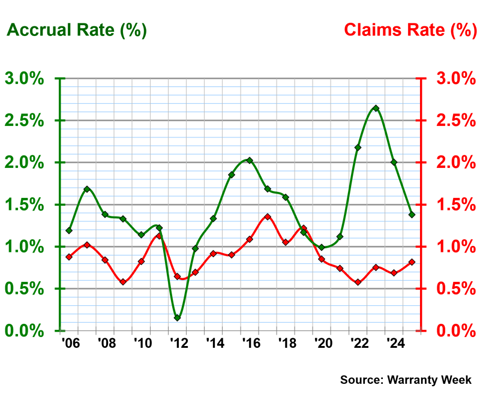
BYD surpassed Tesla in total global EV sales in mid-2025, though the two have remained highly competitive. In 2025, one in four new EVs sold in China was manufactured by BYD. 54% of these vehicles were plug-in hybrid EVs (PHEVs), and 46% were battery EVs (BEVs).
In 2025, BYD had a warranty accrual rate of 1.38%, down one-third from 2024, and a warranty claims rate of 0.82%, up one-fifth from 2024.
Tesla and BYD represent more "mature" EV pure-plays, with 15 to 20 years of experience selling electric vehicles, and doing warranty work for them. Although both automakers have seen warranty costs change as they've expanded their global sales, they've had time to analyze the data and finely tune their warranty accounting, in contrast to the newer EV automakers in the rest of this newsletter.
VinFast
Figure 4 shows the VinFast's warranty expense rates, from 2021 to 2025.
Figure 4
Electric Vehicle Manufacturer Warranties:
VinFast, Claims and Accrual Rates,
(as % of product revenue, 2021-2025)
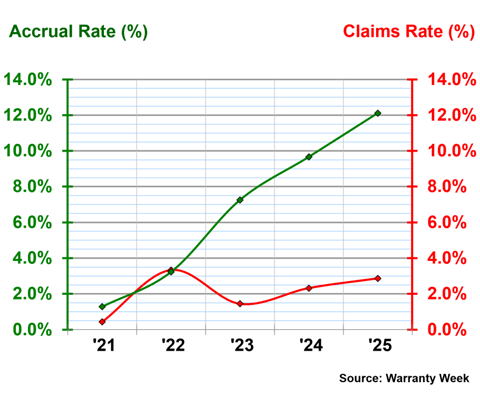
In 2025, VinFast delivered 175,000 EVs in Vietnam, and an additional 22,000 EVs globally, double its 2024 vehicle production.
In 2025, VinFast had a warranty accrual rate of 12.1%, up one-quarter from 2024, and a warranty claims rate of 2.87%, up one-quarter from 2024.
For any new startup automaker in a phase of rapid growth, it makes sense to err on the side of caution, and set aside additional funds in warranty accruals. However, 12% is not a sustainable accrual rate in the long-term.
VinFast is offering very long manufacturer's warranties in international markets, in order to instill consumers' confidence in the reliability and quality of the Vietnamese brand. VinFast provides a 10-year/200,000 km (or 125,000 mi in the U.S.) limited warranty, and covers the battery with a 10-year, unlimited mileage warranty as well. VinFast's manufacturer's warranty coverage includes roadside assistance for all 10 years. These limited warranties are also transferrable upon the sale of the vehicle.
That sounds like a warranty program more costly and extensive than most. It's an opportunity for VinFast to differentiate itself, but if the claims rate rises to the same level as the accrual rate, VinFast will find its warranty program getting in the way of profit.
Rivian
Figure 5 shows Rivian's quarterly warranty expense rates, from 2022 to 2025.
Figure 5
Electric Vehicle Manufacturer Warranties:
Rivian, Claims and Accrual Rates,
(as % of product revenue, 2022-2025)
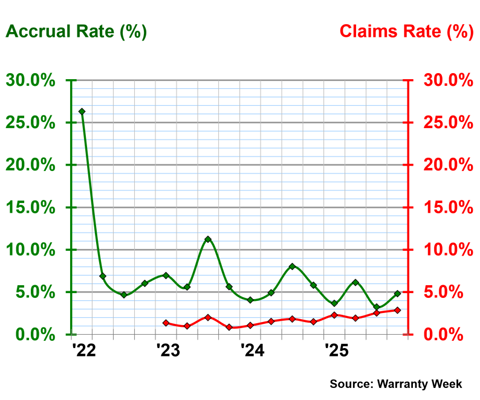
Rivian delivered 42,000 vehicles globally in 2025. Rivian is 16% owned by Volkswagen, and 12% owned by Amazon. The EV automaker faced recall challenges in 2025.
In February 2025, Rivian recalled 17,000 vehicles from the 2025 model year for a headlight issue. In December 2025, Rivian recalled about 35,000 delivery vans due to a seatbelt defect. And in January 2026, Rivian recalled about 20,000 vehicles due to an incorrectly assembled rear toe link.
Likely as a result of these recall costs, in 2025, Rivian had an average warranty claims rate of 2.41%, a two-thirds increase from 2024. In 2025, Rivian had an average warranty accrual rate of 4.47%, a decrease of one-quarter from 2024.
Lucid
Figure 6 shows Lucid Motors' warranty expense rates, 2022 to 2025.
Figure 6
Electric Vehicle Manufacturer Warranties:
Lucid, Claims and Accrual Rates,
(as % of product revenue, 2022-2025)
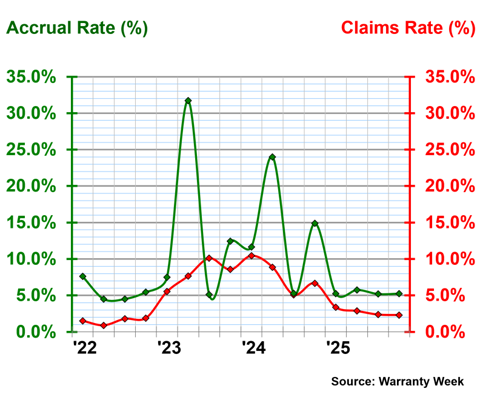
Since 2019, Lucid Motors is 60% owned by the Saudi Arabia Public Investment Fund, the sovereign wealth fund of Saudi Arabia's royal family.
In 2025, Lucid had an average warranty accrual rate of 5.36%, and an average warranty claims rate of 2.73%. Both metrics decreased by about two-thirds from 2024 to 2025.
Polestar
Figure 7 shows Polestar's warranty expense rates from 2020 to 2025.
Figure 7
Electric Vehicle Manufacturer Warranties:
Polestar, Claims and Accrual Rates,
(as % of product revenue, 2020-2025)
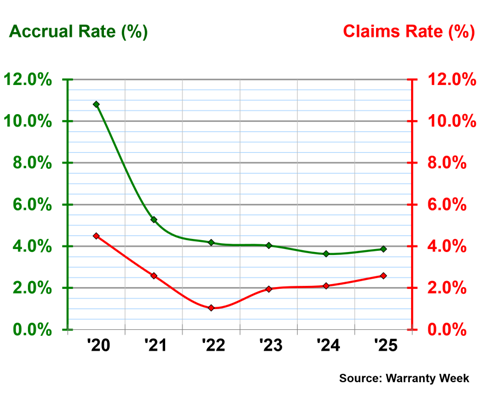
In June 2026, the U.S. Department of Commerce’s Bureau of Industry and Security decreed that Polestar will not be able to sell vehicles beyond the 2027 model year in the U.S., due to its Geely Group ownership. Polestar opened a factory in South Carolina in 2024, in an attempt to comply with the former $7,500 EV tax credit. However, the Bureau says that Polestar violates the "Connected Vehicle Rule," which prohibits the U.S. sale of vehicles and technology from China and Russia.
In 2025, Polestar had an average warranty accrual rate of 3.86%, about the same as the year prior, and an average warranty claims rate of 2.59%, up by about one-quarter from 2024.
Xpeng
Figure 8 shows Xpeng's warranty expense rates from 2018 to 2025.
Figure 8
Electric Vehicle Manufacturer Warranties:
Xpeng, Claims and Accrual Rates,
(as % of product revenue, 2018-2025)
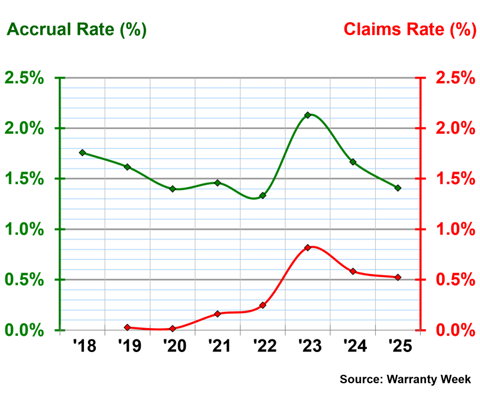
Xpeng offers a large fast charger network across China, and has announced intentions to build a charging network in Europe. Volkswagen acquired a 5% stake in Xpeng in 2023, launching a partnership between the two automakers to design EVs for the Chinese market. In addition to helping Volkswagen sell EVs in China, Xpeng exports EVs to Israel, Norway, Denmark, and about 20 other countries.
In 2025, Xpeng had a warranty accrual rate of 1.41%, down about one-sixth from 2024, and a warranty claims rate of 0.52%, down a bit as well.
Nio
Figure 9 shows Nio's warranty expense rates from 2018 to 2025.
Figure 9
Electric Vehicle Manufacturer Warranties:
Nio, Claims and Accrual Rates,
(as % of product revenue, 2018-2025)
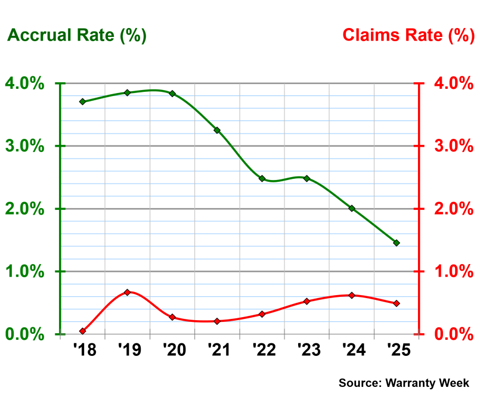
Nio offers a unique style of EV, using "battery swap" technology rather than relying on a charging network. Nio has about 3,800 battery swap stations in China, and about 60 in Europe, primarily in Germany, Norway, the Netherlands, and Sweden. Nio averaged 95,000 daily battery swaps in China in September 2025.
In 2025, Nio had a warranty accrual rate of 1.46%, down about one-quarter from 2024, and a warranty claims rate of 0.49%, down about one-fifth.
Li Auto
Figure 10 shows Li Auto's warranty expense rates, from 2019 to 2025.
Figure 10
Electric Vehicle Manufacturer Warranties:
Li Auto, Claims and Accrual Rates,
(as % of product revenue, 2019-2025)
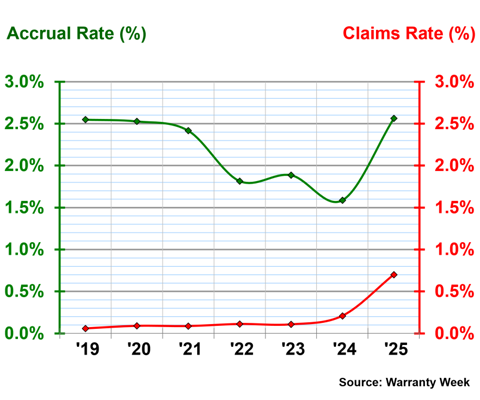
Li Auto makes extended range EVs, or EREVs, which use a built-in petrol engine to charge the battery, extending the range of the battery between charges. It's similar to how the old Chevy Volt worked, though GM ceased production of that model back in 2019. EREVs are different from PHEVs; although both use an electric motor and secondary gas engine, the function of that ICE component is different.
In addition to China, Li Auto sells vehicles in Uzbekistan, where it opened its first overseas dealership in 2025, along with exports to Kazakhstan, Saudi Arabia, the UAE, Russia, and Belarus.
In 2025, Li Auto had a warranty accrual rate of 2.56%, an increase of two-thirds from 2024, and a warranty claims rate of 0.70%, triple the 2024 claims rate of just 0.21%.
More newsletters on the 2025 warranty expenses of worldwide automakers:
- U.S. Auto Warranty Expenses
- European Automaker Warranty Expenses
- Top Japanese Automaker Warranty Expenses
- Mid-Year U.S. Auto Warranty Expenses
- Top Korean & Indian Automaker Warranty Expenses